
TerraMosaic Daily Digest: September 27, 2026
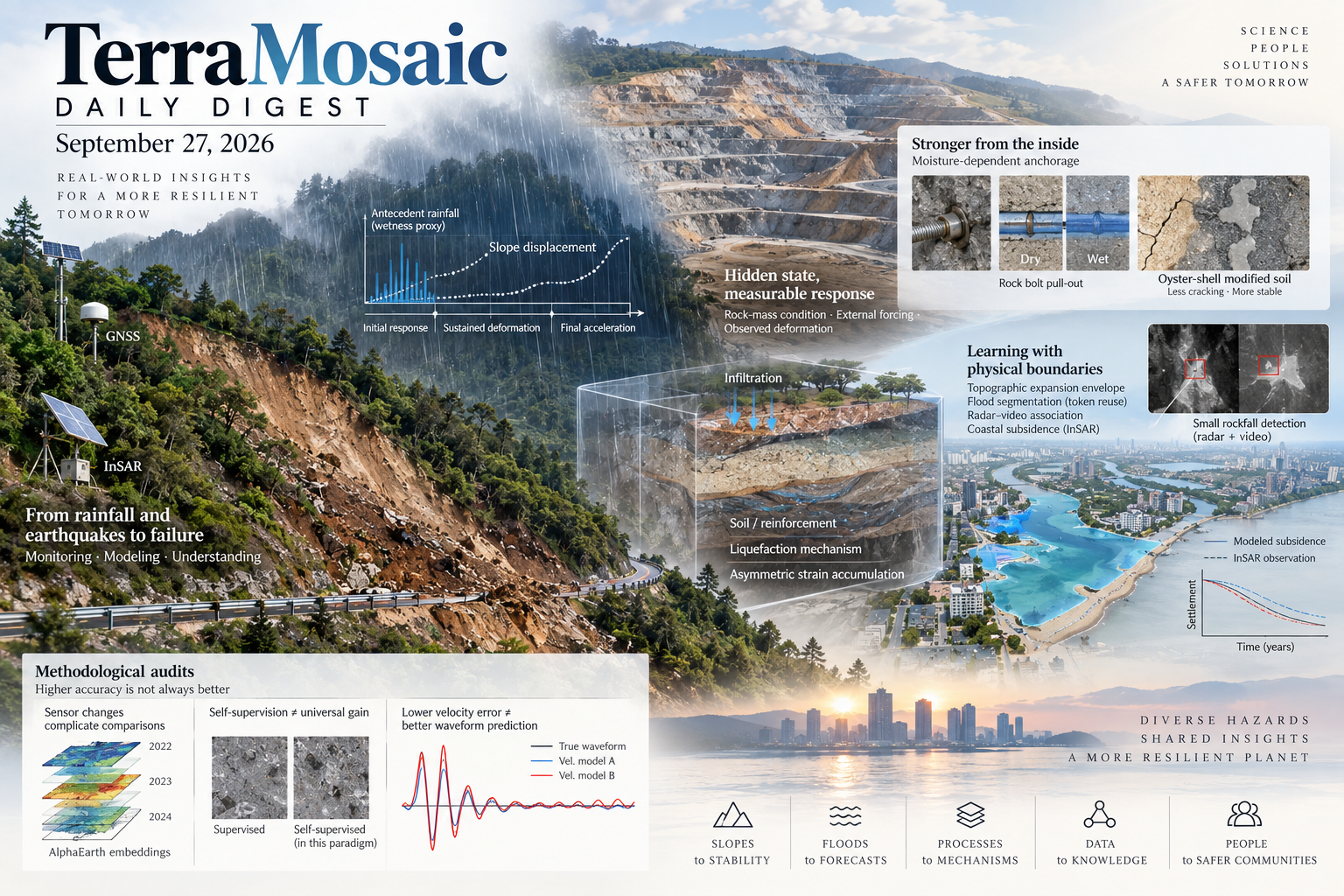
Daily Summary
Rainfall-driven and seismic slope studies link displacement to antecedent conditions and loading history. Monitoring in Songxi distinguishes initial rainfall response, sustained deformation and final acceleration, with antecedent effective rainfall acting as a wetness proxy rather than a direct pore-pressure measurement. For earthquake loading, a probability-density-evolution framework retains mainshock-aftershock accumulation and identifies cumulative absolute velocity as a controlling measure among the tested inputs. A complementary open-pit framework separates latent rock-mass condition, external forcing and observed response; its state-estimation tests do not yet establish a universal failure threshold.
Hydromechanical studies connect changing material state to reinforcement and deformation. Rock-resin shear and bolt pull-out tests quantify moisture-dependent anchorage loss, which is incorporated into rainfall-infiltration simulations. An oyster-shell and modified-soil fill reduces cracking and moisture fluctuations in model tests, supporting infiltration-control potential without demonstrating watershed-scale stabilization. In liquefied sand, a state-bounded hypoplastic mechanism reproduces asymmetric strain accumulation while suppressing persistent numerical ratcheting. These contributions identify mechanisms that static strength parameters or unrestricted cumulative-strain rules can miss.
Topographic expansion envelopes limit implausible flood spread in a learned inundation model, while token reuse accelerates flood segmentation in oblique aerial video. Radar-video association tracks small rockfalls through intermittent visibility, although its field evaluation covers only five sequences. In coastal reclamation, modeled subsidence patterns are consistent with settlement and InSAR evidence, but delayed compression is represented by equivalent parameter corrections rather than explicit creep evolution.
Methodological audits expose limits that higher average accuracy can conceal. An AlphaEarth preprint finds that sensor changes complicate comparison of annual embeddings. A change-detection study questions the contribution of self-supervised training within one specific processing paradigm, not self-supervision in general. Matched-budget seismic inversions further show that lower velocity error need not improve prediction of unseen waveforms. Together, these studies distinguish useful representations, faithful physical reconstruction and validation on observations withheld from fitting.
Key Trends
The main methodological contributions retain physical state, constrain cumulative response and test whether computational gains survive observation-specific validation.
- State and loading history enter failure models: Rainfall-stage monitoring, mainshock-aftershock reliability and hidden rock-mass estimation retain antecedent conditions and evolving state instead of relying only on forcing maxima.
- Constitutive and interface mechanisms constrain accumulation: Moisture-dependent anchorage updates connect infiltration to bond loss; bounded post-liquefaction evolution distinguishes finite directional strain from artificial long-cycle ratcheting.
- Physical constraints and sensor association support event monitoring: Terrain-derived expansion envelopes restrict predicted flood extent. Radar-guided search regions and gated video assignment address a different constraint: maintaining object identity through intermittent visibility.
- Validation separates representation quality from physical fidelity: Earth-embedding audits, random-feature change-detection controls and held-out seismic waveforms test different failure modes. A better fit to one target does not validate another observable.
- Inference adapts to observation and compute budgets: Temporal token reuse exploits stable patches in overlapping video frames. Learned particle-filter proposals improve sampling efficiency, while shared field operators separate evolving dynamics from changes in sensor placement.
Selected Papers
Rainfall-driven slope evolution, earthquake-sequence displacement and moisture-sensitive reinforcement lead the geohazard studies. Flood and rockfall monitoring connect physical constraints with multi-sensor observations. Complementary work covers liquefaction, subsidence, geophysical inversion and transferable remote-sensing and statistical methods.
1. Stage-based deformation preceding rainfall-induced landslide failure in Songxi County, China
Core Problem: Rainfall totals alone do not describe the deformation state preceding failure.
Key Innovation: Two Songxi landslides are investigated with field, laboratory and monitoring evidence; one slope's 2022 deformation and 2024 failure link antecedent effective rainfall to sustained movement and final acceleration. Effective rainfall is a wetness proxy, not a pore-pressure measurement.
2. Reliability analysis method for soil slopes permanent displacement under mainshock-aftershock sequences
Core Problem: Mainshock-only analysis can omit displacement accumulated under aftershocks.
Key Innovation: A probability-density-evolution framework evaluates permanent displacement under seismic sequences; cumulative absolute velocity emerges as a controlling measure among 21 tested inputs, rather than relying on peak acceleration alone.
3. Rainfall Induced Degradation of Rockbolt Anchorage: Experimental Tests and Numerical Simulation
Core Problem: Sustained infiltration changes the bond strength of resin-anchored bolts.
Key Innovation: Interface shear and pull-out experiments inform moisture-dependent cable-element updates. Strength and load reductions are tied to tested moisture conditions and a specified rainfall simulation, not universal degradation rates.
4. State-bounded directional accumulation in post-liquefaction sand: A hypoplastic formulation for asymmetric cyclic deformation
Core Problem: Sand models can accumulate unbounded directional strain after liquefaction.
Key Innovation: A state-bounded hypoplastic mechanism uses one additional parameter to reproduce extension-biased but finite accumulation, with unchanged-parameter and cross-path tests plus long-cycle ablations.
5. Hidden rock mass state theory: A physics-informed state estimation framework for next-generation Digital Twins in open-pit rock engineering
Core Problem: Measured deformation does not uniquely reveal the physical state governing rock response.
Key Innovation: The HRMS framework separates hidden physical state, external forcing and observations across mining environments. Omission, perturbation and withheld-observation tests support state inference, but do not establish a universal failure-warning threshold.
6. Explaining Ground-Motion Residuals at Two Strong-Motion Stations in Southeastern New York: Sediment Resonance and Topographic Amplification
Core Problem: Proxy site descriptors do not explain large station-specific ground-motion residuals.
Key Innovation: Surface-wave and noise measurements support sediment resonance at Caumsett and directional topographic amplification at the Palisades following the Tewksbury earthquake. This is an arXiv preprint.
7. CA-DSUNet: A Novel Physics-Prior-Guided Dual-Stream Deep Coupling Network for Flood Inundated Area Forecasting in Emergent Support
Core Problem: Unconstrained sequence models can predict implausible overflow.
Key Innovation: Cellular-automaton expansion envelopes bound a dual-stream network combining flood history and terrain. Poyang and Dongting tests support the approach; overall IoU must be distinguished from skill at changing flood margins.
8. Efficient On-Board Processing of Oblique AAV Video for Rapid Flood Extent Mapping
Core Problem: Embedded hardware limits rapid segmentation of oblique aerial video.
Key Innovation: Temporal token reuse bypasses repeated feature computation in stable image patches, giving 1.58–1.69-fold speedups on tested videos with less than one percentage point mIoU loss; still-image benefits are not implied.
9. From Coseismic Disturbance to Short-Term Dynamic Recovery: Nighttime Light Perspective on the Disaster Response to the Myanmar Mw 7.7 Earthquake
Core Problem: Immediate damage and month-scale recovery have distinct spatial trajectories.
Key Innovation: Black Marble nighttime lights identify heterogeneous post-Myanmar-earthquake recovery patterns; light restoration is an activity proxy, not direct verification of repaired buildings or full social recovery.
10. Spatiotemporal evolution of land subsidence in coastal reclamation areas: coupling anthropogenic land-use intensity and delayed soft-soil compression
Core Problem: Changing land use and delayed soft-soil compression interact in reclaimed ground.
Key Innovation: Borehole-constrained modeling and settlement observations support conditional Ningbo screening scenarios. Equivalent parameter corrections do not simulate constitutive creep, and spatial consistency with InSAR is not independent full-domain validation.
11. From waste to a watershed-scale solution: Transforming oyster shell and expansive soil into a hydrophobic barrier for intercepting rainfall recharge and stabilizing slopes
Core Problem: Cracks provide infiltration routes that conventional fill materials may not reliably seal.
Key Innovation: Oyster-shell, expansive-soil and octadecylamine mixtures reduce cracking and moisture fluctuations in laboratory and 134-day model tests. The evidence supports a hydrophobic material, not demonstrated watershed-scale stabilization or a universal superhydrophobic threshold.
12. Debris Flow Susceptibility Mapping Using Explainable Deep Learning in Eastern Hindukush Pakistan
Core Problem: Mountain hazard inventories must be related to terrain, rainfall and human disturbance.
Key Innovation: A 30 m CNN–SHAP model uses 13 factors in eastern Hindu Kush and reports AUC 0.94 with density-based checking. The available abstract does not establish spatially independent or cross-region validation; SHAP describes model associations rather than causal controls.
13. Instability risk assessment of submarine strata based on data-driven modelling and interpretable machine learning algorithms
Core Problem: Small borehole datasets provide incomplete evidence of engineering instability.
Key Innovation: Clustering-derived grades and interpretable classifiers use 120 soil samples; the best reported accuracy is 0.639. Agreement with derived labels is not validation against an independent failure inventory.
14. Time-dependent response of a loaded pile under excavation- and dewatering-induced non-Darcy reverse consolidation
Core Problem: Excavation changes consolidation history and pile contact conditions.
Key Innovation: A sequential one-way soil-to-pile model combines non-Darcy flow, fractional soil response and unilateral contact, with analytical and numerical checks. It excludes pile-to-soil feedback.
15. Research on Mining Area Surface Subsidence Based on Time-Series InSAR Images and Deep Learning Models
Core Problem: Regional subsidence retrieval and prediction depend on stable interferometric references.
Key Innovation: PS-stable-point constraints improve SBAS processing before a spatiotemporal model predicts mining deformation. Pixel-scale test error does not establish mine-to-mine generalization.
16. The Role of Multi-Sensor Satellite Remote Sensing in Characterizing Volcanic Plumes Relevant to Climate Forcing
Core Problem: Different sensors observe different plume constituents and atmospheric effects.
Key Innovation: A review combines ultraviolet through thermal-infrared perspectives on recent eruptions, separating plume characterization from downstream climatic interpretation.
17. Radar-Video Fusion for Tiny Rockfall Detection and Tracking in Complex Field Environments
Core Problem: Tiny moving blocks are intermittently visible and difficult to associate across sensors.
Key Innovation: Radar-guided search regions and gated assignment maintain fused identities in five field sequences with 22 trajectories. Reported F1 is 0.731 and identity F1 is 0.702 at the primary 20-pixel criterion; these results characterize a single-site prototype, not broad operational validation.
18. A distributed parallel processing framework for sentinel-1 wide-area time series InSAR: Application in Jining City
Core Problem: Wide-area processing and mosaicking can be costly on modest hardware.
Key Innovation: Burst-level parallel processing, polynomial correction and weighted blending map Jining mining subsidence, with field-observed road and building damage supporting site relevance.
19. Volcanic stratigraphy offshore East Montserrat: Selective preservation and subaqueous remobilisation in marine records
Core Problem: Offshore deposits may not preserve a complete eruption history.
Key Innovation: Two Montserrat cores show selective ash preservation and remobilisation; multi-proxy analysis cautions against assigning every marine layer directly to a monitored onshore event.
20. A multi-dimensional cloud-model-based fuzzy evaluation method for grading nonlinear tunnel large deformation
Core Problem: Uncertain grade boundaries and indicator weights hinder cross-project assessment.
Key Innovation: Asymmetric cloud memberships and coupled indicator weights are evaluated on three tunnel datasets; grading accuracy alone is not calibrated event probability.
21. Propagation of Blast-Induced Ground Vibration and Its Effect on Building Infrastructures: A Review
Core Problem: Vibration prediction and building response are governed by site and loading conditions.
Key Innovation: Reviews wave generation, empirical and numerical models, explosive loading and structural-response limits, distinguishing blast excitation from earthquake motion.
22. A time-dependent solution for excavation-induced vertical deformation of underlying existing tunnels in two-layered saturated ground based on Biot consolidation theory
Core Problem: Underlying tunnels deform as layered saturated ground consolidates around excavations.
Key Innovation: The same-title author preprint couples Biot consolidation with beam response and compares deformation with centrifuge observations. Journal identity is verified; equivalence of precursor and final validation remains unverified.
Method evidence: Author preprint; journal-version equivalence not established.
23. Predicting ground motion intensity measures in Japan using a hybrid artificial neural network integrated with Taguchi optimization
Core Problem: Regional intensity prediction requires relationships between event, path and site information.
Key Innovation: The same-title author preprint couples neural prediction with Taguchi optimization and mixed-effects variability analysis. Journal identity is verified; precursor and final validation are not assumed equivalent.
Method evidence: Author preprint; journal-version equivalence not established.
24. KG-SubNet: A Knowledge-Guided Deep Learning Framework for 3D Mining Subsidence Retrieval from InSAR Interferograms
Core Problem: Title-level focus: Line-of-sight interferometry does not directly expose full three-dimensional displacement.
Key Innovation: The title identifies knowledge-guided neural retrieval of mining subsidence from interferograms. Methods, data and results could not be assessed from a reliable abstract.
25. BMINN: A neural network for bedrock motion inversion from ground motion
Core Problem: Title-level focus: Surface shaking must be related to the motion entering underlying bedrock.
Key Innovation: The title uses a neural network for inverse estimation of bedrock motion from ground-motion records. Methods, data and results could not be assessed from a reliable abstract.
26. GUARD-net: A geostationary satellite-based network for near-real-time active fire detection under class imbalance
Core Problem: Title-level focus: Rare fire pixels create class imbalance in continuous satellite monitoring.
Key Innovation: The title identifies a geostationary fire-detection network that explicitly addresses class imbalance. Methods, data and results could not be assessed from a reliable abstract.
27. Large-scale landslide susceptibility mapping via deep learning: A case study of Pakistan
Core Problem: Title-level focus: Large-area susceptibility modeling must generalize across heterogeneous terrain.
Key Innovation: The title applies deep learning to Pakistan-wide landslide susceptibility; inventory quality and spatial validation cannot be assessed from the available metadata. Methods, data and results could not be assessed from a reliable abstract.
28. An optimization approach for underground cavern layouts utilizing the surrounding rock disturbance contribution of primary and secondary caverns
Core Problem: Title-level focus: Primary and secondary excavations contribute differently to surrounding-rock disturbance.
Key Innovation: The title uses these contributions to optimize underground cavern layouts. Methods, data and results could not be assessed from a reliable abstract.
29. Seismic fragility and risk assessment of existing long-span precast industrial buildings retrofitted with different techniques
Core Problem: Title-level focus: Retrofit choices require comparable fragility and risk estimates.
Key Innovation: The title compares retrofit techniques for long-span precast industrial buildings. Methods, data and results could not be assessed from a reliable abstract.
30. Cyclic liquefaction behavior of weakly cemented and fines-treated sands with gradation effects
Core Problem: Title-level focus: Weak cementation, fines and gradation jointly affect cyclic soil behavior.
Key Innovation: The title evaluates liquefaction response across these material conditions. Methods, data and results could not be assessed from a reliable abstract.
31. Centrifuge modeling of tunnel-depth effects on seismic response of soil-tunnel systems
Core Problem: Title-level focus: Embedment depth changes soil–tunnel interaction under shaking.
Key Innovation: The title uses centrifuge models to isolate tunnel-depth effects on seismic response. Methods, data and results could not be assessed from a reliable abstract.
32. A Hysteresis-Based Framework for Evaluating and Selecting Streamflow Monitoring Approaches Under Unsteady Gradually Varied Flow Conditions
Core Problem: A single stage–discharge curve misses unsteady-flow hysteresis and uncertainty.
Key Innovation: A three-part metric separates flow deviation, peak timing and cumulative volume, with comparisons at three USGS stations to guide monitoring-method selection.
33. Learning coarse-step dynamics and internal mechanical response with graph networks
Core Problem: Coarse trajectory observations hide internal mechanical response.
Key Innovation: A Newmark-inspired graph update and virtual hub support coarse-step dynamics and recover aspects of beam stiffness without force supervision; geomechanical transfer requires validation.
34. AlphaEarth distinguishes cities but compresses urban variation
Core Problem: Globally shared Earth embeddings may not preserve urban detail or temporal comparability.
Key Innovation: An AlphaEarth audit across 1,000 urban areas identifies uneven within-city variation and sensor-related annual changes. Cross-region utility does not establish validity for year-to-year change detection.
35. Learning to Bias: Machine Learning-Enhanced Particle Filters
Core Problem: Poor proposals reduce particle-filter efficiency.
Key Innovation: Learned one-step conditional proposals are corrected by importance weights, preserving the filtering target under stated support and density assumptions while improving nonlinear benchmarks.
36. When 10,000 Windows Are Not 10,000 Tests: Auditing Statistical Confidence in Sliding-Window Time-Series Classification
Core Problem: Overlapping windows inflate apparent test sample size.
Key Innovation: An audit separates recording- and subject-level estimands and dependence-robust intervals, showing that more windows do not provide proportional independent evidence.
37. Mechanism-Aware Ensemble Conditioning for Data-Limited Emulation of Extreme Events
Core Problem: Short trajectories undersample transient instability and distribution tails.
Key Innovation: Coarse-ensemble covariance conditions learned dynamics through FiLM; controlled chaotic and quasi-geostrophic tests assess exceedance statistics rather than only mean error.
38. Adaptive Interaction Graphs for Particle Simulation
Core Problem: Fixed interaction graphs miss spatially concentrated simulation complexity.
Key Innovation: A variance head expands particle neighborhoods using the preceding step's uncertainty, improving WaterDrop and producing more modest Sand gains; long-horizon benefits are problem-dependent.
39. Learning Hierarchical Causal Representations of the Effects of Forcings on Temperature in Climate Models
Core Problem: Black-box climate emulators blur forced response and internal variability.
Key Innovation: Hierarchical representations separate atmospheric dynamics from greenhouse-gas and aerosol forcing and test responses on unseen climate scenarios.
40. Aurora-X: Built for Extreme Time Series Forecasting
Core Problem: Forecasting backbones must accommodate covariates, cross-variable dependence and varied resolutions.
Key Innovation: Aurora-X combines a progressive curriculum, pattern-guided sparse experts and arbitrary-quantile prediction. Benchmark breadth does not yet establish geohazard forecasting superiority.
41. Data-driven analysis of muon flux variations in muography time series at the Sos Enattos Mine
Core Problem: Predefined regions can conceal localized geophysical variability.
Key Innovation: Overlapping sightline blocks and PCA identify coherent and delayed flux changes in two mine acquisitions; flux components are not automatically resolved density-change mechanisms.
42. From Image Morphology to Multiphysics Earth Posteriors
Core Problem: Morphological priors and physical-property likelihoods provide different information.
Key Innovation: Frozen image-derived coordinates support velocity and density inversion, but smooth bases win on some targets and cross-property coupling can worsen blind predictions.
43. Wave-Propagation Geometry Emerges from Scalar Travel-Time Relations
Core Problem: Accurate travel-time fitting need not imply reliable spatial derivatives.
Key Innovation: Controlled neural and classical representations recover conditional propagation geometry; field comparisons and scalar-matched perturbations expose derivative and lateral-resolution limits.
44. Structure-dependent failure modes of neural priors in acoustic full-waveform inversion
Core Problem: Low velocity error can conceal poor prediction of unseen seismic data.
Key Innovation: Matched-budget acoustic inversions compare grids and neural priors; rankings change with structure, and the grid baseline predicts held-out shots better in the reported tests.
45. More Sensors Only One Field: Rethinking Continual Spatio-Temporal Forecasting
Core Problem: Sensor expansion changes observations without necessarily changing field dynamics.
Key Innovation: A shared field-evolution operator separates observation/query interfaces from latent dynamics and conditions propagation on spatial regime, tested on evolving sensor networks.
46. ContraFM-S2O: Flow Matching-Based One-step SAR-to-Optical Image Translation Model with Contrastive Learning
Core Problem: Image translation must balance detail with sampling latency.
Key Innovation: Contrastive flow matching learns average transport velocity for one-step synthesis. Generated optical appearance is not a substitute for an independent optical observation.
47. NEXT: Physics-Informed Neuro-Spectral Exponential Time Differencing Architectures
Core Problem: Spectral neural integration can diverge on stiff dynamics.
Key Innovation: NEXT integrates the linear stiff component through exponentials while learning the remaining dynamics, with forward and inverse PDE tests.
48. Training Graph Foundation Models on The Web Graph
Core Problem: New graphs change feature dimensions, labels and task structure.
Key Innovation: Acacia is trained on a web graph to support several graph tasks without added heads or LLM components; transfer to physical hazard networks is not yet demonstrated.
49. ChronoFuseGS: Multi-Temporal Gaussian Fusion with Per-Splat Persistence and Change Visualization
Core Problem: Independent scene models waste persistent structure and obscure fine changes.
Key Innovation: ChronoFuseGS fuses time-specific Gaussian models with per-primitive persistence, evaluated over eight surveys of a flood-management area across seven months.
50. AUWave: A Data-Driven Model for Reconstructing Significant Wave Heights Using Sparse Observations
Core Problem: Sparse stations cannot directly resolve regional wave-height fields.
Key Innovation: AUWave combines station encoders and a multi-scale attention U-Net, evaluates buoy removal and cross-basin transfer, and distinguishes near-station accuracy from remote reconstruction.
51. FVT: Feature-to-Video Transition Modeling for Semantic Change Detection
Core Problem: Two-date features can lose directional semantic transitions.
Key Innovation: Feature-to-video representations and bidirectional evolution modules model from–to changes on SECOND and Landsat-SCD. Synthesized transitions are representations, not observed intermediate images.
52. Revisiting the Effectiveness of Self-Supervised Learning for Change Detection in Remote Sensing Imagery
Core Problem: Self-supervised training may be credited for useful features already present without learning.
Key Innovation: Within a specified contrastive-pretraining and unsupervised-postprocessing setup, random and single-layer controls challenge attribution of performance gains to pretraining; the finding is not universal to all self-supervised methods.
53. TempLocate: Endpoint-Supervised Temporal Change Localization for Time-Series Change Detection
Core Problem: Intermediate-time labels are expensive to obtain.
Key Innovation: Endpoint supervision calibrates adjacent temporal differences and consistency constraints, evaluated on DynamicEarthNet and SpaceNet7.
54. A Review of Hyperspectral Unmixing Considering Spectral Variability
Core Problem: Spectral variability undermines fixed-endmember assumptions.
Key Innovation: Reviews model-driven, data-driven and hybrid unmixing across single- and multi-temporal settings, including datasets and evaluation comparisons.
55. Few-Shot Hyperspectral Image Classification: A Review of Deep Architectures, Paradigms, and Benchmarks
Core Problem: Reported low-label classification gains are difficult to compare across protocols.
Key Innovation: A review and common benchmark compare architectures and learning paradigms, keeping scarce-label performance distinct from cross-domain validation.
56. Daily snow depth in the Southern Andes (2010-2024): a quality-controlled dataset from Chile and Argentina
Core Problem: Sparse and inconsistent gauges impede snowpack assessment.
Key Innovation: Compiles daily depths from 81 Andean stations for 2010–2024 with physical-consistency checks; quality filtering improves reliability while reducing availability.
57. Extension of the Japan Aerospace Exploration Agency long-term Northern Hemisphere snow cover extent product beyond half a century
Core Problem: Sensor transitions complicate extension of long snow records.
Key Innovation: Extends JAXA Northern Hemisphere snow observations beyond half a century, with ground checks and separate wet-snow performance; this is an ESSD discussion preprint.
58. Effectively assimilate satellite land surface temperature into offline land surface models within ensemble-based assimilation frameworks
Core Problem: Rapidly changing skin temperature complicates assimilation into land models.
Key Innovation: Joint soil-temperature and soil-moisture updates improve some subsurface and snow variables despite marginal surface-temperature gains, separating target fit from state improvement.
59. Investigating terrestrial water storage change in a western Canadian river basin with GRACE/GRACE-FO and fully-integrated groundwater - surface water modelling
Core Problem: Satellite total storage does not isolate groundwater, soil, surface and snow components.
Key Innovation: GRACE/GRACE-FO comparisons support integrated HydroGeoSphere analysis in western Canada; correlation of total storage does not independently validate each component.
60. Feature attention model for soil-geocomposite interface strength
Core Problem: Small geotechnical datasets contain interacting controls on interface shear strength.
Key Innovation: Attention-based prediction and an extracted empirical expression use large-scale direct-shear data; test accuracy and engineering-formula validation are reported separately.
61. A Freeze-thaw damage model for rock based on equivalent pore structure
Core Problem: Porosity, strength and permeability need not deteriorate together.
Key Innovation: An equivalent-pore model captures contrasting damage modes in granite and sandstones but underestimates sandstone permeability, limiting hydraulic interpretation.
62. Thermoplastic stabilisation of floating energy pile settlement: A TSL-enhanced constitutive model and finite-element analysis
Core Problem: Thermal cycles can cause pile settlement that existing models over- or under-accumulate.
Key Innovation: A stabilization-line enhancement links element tests and centrifuge observations to pile response; fifty-cycle behavior is a model projection rather than a fifty-cycle field record.
63. Efficient reliability analysis of laterally loaded offshore monopile in spatially variable clays: A DeepONet-based approach
Core Problem: Title-level focus: Spatially variable clay makes repeated lateral pile reliability calculations costly.
Key Innovation: The title proposes a DeepONet surrogate for laterally loaded offshore monopile reliability; no hazard-specific loading outcome is inferred. Methods, data and results could not be assessed from a reliable abstract.
64. HotSAM: A Hotspot-Spatial-Adaptive Multi-Resolution framework for efficient long-term deformation monitoring in terrestrial radar interferometry
Core Problem: Title-level focus: Long interferometric records can require expensive uniform-resolution processing.
Key Innovation: The title describes hotspot-adaptive multi-resolution deformation monitoring; abstract-level performance evidence is unavailable. Methods, data and results could not be assessed from a reliable abstract.
65. A knowledge-informed cascaded model for rainfall erosivity estimation in China
Core Problem: Title-level focus: Rainfall erosion potential requires estimates beyond rainfall totals alone.
Key Innovation: The title uses a knowledge-informed cascade to estimate erosivity across China. Methods, data and results could not be assessed from a reliable abstract.
66. Stress-dependent permeability of chemo- and bio-grout rock fractures: Implications for flow control in underground storage systems
Core Problem: Title-level focus: Grouting performance can change as fracture stress and aperture evolve.
Key Innovation: The title compares permeability of chemically and biologically grouted fractures under stress, with underground-storage flow-control relevance. Methods, data and results could not be assessed from a reliable abstract.
67. A parametrically optimized multichannel impact-echo system for void detection in tunnel linings
Core Problem: Title-level focus: Hidden voids in linings require interpretable nondestructive observations.
Key Innovation: The title describes a parametrically optimized multichannel impact-echo system for void detection. Methods, data and results could not be assessed from a reliable abstract.
68. Investigation of Radial Pore-Water Pressure Response and Thermo-Hydraulic Coupling Mechanisms in Tunnel Surrounding Rock Influenced by Lining Stiffness: Insights from One-Dimensional Freeze? Thaw Tests under Elastic Confinement
Core Problem: Title-level focus: Lining stiffness constrains thermally induced pore-pressure evolution.
Key Innovation: The title examines radial pressure and thermal–hydraulic coupling through one-dimensional freeze–thaw tests under elastic confinement. Methods, data and results could not be assessed from a reliable abstract.
69. First Application of a Coastal-Dune Model (AeoLiS) to Simulate Fluvial-Aeolian Morphodynamics
Core Problem: Coastal aeolian models may not describe river-corridor sediment behavior.
Key Innovation: AeoLiS reproduces observed Grand Canyon sandbar changes under simplified grain size, vegetation and sediment-supply assumptions.
70. Noise Stability and Rotational Equivariance of Image-Induced Hamiltonian Spectra for Robust Unsupervised Segmentation
Core Problem: Sensor noise and rotation can destabilize spectral image segmentation.
Key Innovation: Derives spectral-gap-dependent perturbation bounds and mask-stability conditions, then tests them on noisy imagery; transfer to remote sensing remains untested.
71. When Does Advection-Aware Graph Nowcasting Help? A Controlled Study of Distributed Solar Ramp Forecasting with a Self-Supervised Cloud-Motion Estimator
Core Problem: Motion-informed sensor graphs may add complexity without improving forecasts.
Key Innovation: Controlled cloud-motion simulations separate motion-estimation quality from graph design; useful advection requires forecast displacement to fit within the sensor network. Real-network validation remains open.
72. Staged Depth Training: A Representation Curriculum for PINNs
Core Problem: Implicitly learned representations can hinder PINN optimization.
Key Innovation: Staged Depth Training freezes shallow learned prefixes before adding depth, improving many equal-budget PDE benchmark configurations without changing deployed architecture.
73. CSCWD: Cross-Scale Channel-wise Knowledge Distillation for Lightweight Tiny Object Detection on Edge Devices
Core Problem: Tiny targets lose spatial evidence in lightweight detectors.
Key Innovation: Cross-scale distillation transfers teacher high-resolution features to a compact detector without increasing its inference architecture, with aerial benchmark and edge-hardware tests.
74. Structure-Guided Masked Autoencoders for Ultra-High Resolution Scientific Image Understanding
Core Problem: Uniform tokens and random masks poorly match very large structured images.
Key Innovation: A quadtree tokenizer and structure-guided masking compress scientific imagery into bounded token sequences, tested in microscopy and CT rather than geohazard imagery.
75. SAGE: Source-Anchored Guidance via Frequency Equalization for Hierarchical RGB-T Alignment and Fusion
Core Problem: Misregistration produces ghosting and uneven cross-modal information.
Key Innovation: Frequency equalization propagates low-frequency geometric guidance into hierarchical alignment and wavelet-subband fusion, evaluated under real and synthetic misalignment.
76. NEMSim: Learning Control-Conditioned Multi-Event Physical Dynamics via Executable Event-Mechanism Priors
Core Problem: Limited trajectories make controlled multi-event systems difficult to emulate.
Key Innovation: Executable event rules constrain neural transition structure on a kinetic Monte Carlo benchmark; the evidence concerns that benchmark, not natural-hazard event chains.
77. Deep Pseudo-Proximal Map: A Self-Supervised Data-Fitting Agent for Iterative Reconstruction
Core Problem: Repeated inner solvers dominate data-fitting updates.
Key Innovation: A noise-trained pseudo-proximal network replaces iterative likelihood updates, with linear-operator equivalence and tests in deblurring, super-resolution and CT.
78. Learning Provable Neural Network Observer for Uncertain Dynamical Systems
Core Problem: Certifying stable learned observers can require expensive optimization.
Key Innovation: Point-guided pretraining is followed by LMI certification, separating rapid fitting from a global stability constraint on nonlinear control benchmarks.
79. Reliability-Regulated Trajectory Optimization for Progressive COLMAP-Free 3D Gaussian Splatting
Core Problem: Early pose errors propagate through progressive 3D reconstruction.
Key Innovation: Bidirectional consistency gates motion initialization and weights sliding-window corrections, improving COLMAP-free Gaussian reconstruction without external geometric priors.
80. EPOC: Endpoint-Preserving Online Correction With Compressed Residual State for Multi-Horizon Time Series Forecasting
Core Problem: Full residual histories consume memory in multi-horizon adaptation.
Key Innovation: Low-order cosine coefficients plus a shared endpoint provide compact online residual correction, with explicit accuracy–state-size comparisons across fixed forecasters.
81. OneWorld: Learning Consistent Physics Across Actions in World Models
Core Problem: Individually plausible action-conditioned futures can imply incompatible masses or friction.
Key Innovation: OneWorld constrains branches through a shared latent mechanism and tests cross-intervention consistency in controlled environments; this is not a validated disaster simulator.
82. DAPEVO: Deep Adaptive Patch Frame-Event Visual Odometry
Core Problem: Sparse or degraded RGB observations weaken camera tracking.
Key Innovation: Patch-level gating fuses independently estimated frame and event correlations and permits event-only updates, evaluated under frame reduction and image degradation.
83. Gradient Surgery for Physics-Informed Neural Networks
Core Problem: Physics and data objectives can conflict in direction or magnitude.
Key Innovation: Physics-aware gradient surgery adapts to observed conflict phases on four PDE benchmarks; the result is an optimization contribution, not a demonstrated hazard solver.
84. TRACKGRAPH: Online Open-Vocabulary 3D Scene Graphs via Image-Space Tracking
Core Problem: Repeated segmentation and vision-language inference burden persistent 3D mapping.
Key Innovation: TRACKGRAPH propagates masks between sparse keyframes before 3D fusion, with quadruped deployment and aerial-view tests; disaster-scene performance remains unestablished.
85. Band-Selection Stability and Semantic Segmentation Performance: A Study on Hyperspectral City
Core Problem: Stable band subsets do not necessarily preserve downstream segmentation.
Key Innovation: Repeated-sample comparisons separate band stability, subset size and segmentation performance, finding no consistent stability–accuracy association.
86. SAGE: A sampling-aware global evaluation benchmark for species distribution modeling
Core Problem: Sampling bias and prevalence distort performance comparisons of occurrence models.
Key Innovation: A global species benchmark stratifies sampling effort and prevalence and shows the importance of thinning and reweighting; transfer to landslide inventories is methodological.
87. DepthEvidence: Unifying Metric Depth Prediction and Geometric Reasoning in Multimodal Language Models
Core Problem: Language answers may lose numerical information from predicted depth.
Key Innovation: Object-anchored geometry tokens connect camera-conditioned metric depth with language reasoning, evaluated on depth and spatial-query benchmarks.
88. Bayesian Tensor Autoencoder with Physics-informed Predictive Prior for Multi-dimensional Time Series Anomaly Detection
Core Problem: Flattening multidimensional observations discards correlations.
Key Innovation: A tensor autoencoder incorporates a predictive prior through Bayesian fusion. Its stated physical prior is low-rank tensor structure, not a validated conservation law.
89. WorldTS: World Modeling for Multimodal Covariate-aware Time Series Forecasting
Core Problem: External information should influence latent dynamics rather than only final predictions.
Key Innovation: WorldTS learns covariate-conditioned state evolution before fitting a decoder, evaluated on 21 time-series datasets; physical-state identifiability is not established.
90. Self-Supervised Representation Learning: From Spectral Foundation Models to Auroral Emission Spectra
Core Problem: Sparse labels and incompatible wavelength windows constrain spectral pretraining.
Key Innovation: Auroral masked pretraining is compared with optical and infrared foundation models, finding that spectral-domain compatibility matters; geological spectroscopy transfer requires separate validation.
91. WeaveAgent: A Two-Stage Tool-Routing Agent for Ultra-High-Resolution Remote Sensing Imagery
Core Problem: Large imagery makes token allocation and reliable tool invocation difficult.
Key Innovation: WeaveAgent separates tool routing from conditional image/tool execution and reports diagnostic ablations; its small trained system does not establish universal advantage over larger zero-shot baselines.
92. Gauss What You Need: Compact Gaussian Splatting Across Scene Scales
Core Problem: A fixed Gaussian budget does not suit both small and extensive image captures.
Key Innovation: Capture-derived allowances and training feedback adjust model size across scene scales, trading reconstruction quality against storage and rendering cost.
93. LUCID: Learning Under Confounding for Inference and Discovery in Time Series
Core Problem: Latent common causes can create spurious lagged causal edges.
Key Innovation: A spectral router selects a deconfounding strategy before graph discovery, with synthetic tests spanning intermittent and heavy-tailed confounding; real hazard causality remains unverified.
94. Progressive Memory Transformer: Memory-Aware Attention for Time-Series
Core Problem: Global losses can overlook intermediate temporal motifs.
Key Innovation: Window-aligned memory supports separate local, motif and sequence objectives, evaluated through classification, forecasting and cue-retention probes.
95. Brenier Meets Adversarial Training: Optimal Transport Geometry for Robust Learning
Core Problem: Local adversarial perturbations can waste transport cost and poorly represent distribution shift.
Key Innovation: Transport-map constraints and input-convex parameterization enforce geometric consistency in robust learning, tested on regression, images and control rather than geohazards.
96. Implicit Neural Representation for Hyperspectral Video Compression
Core Problem: Framewise coding misses spectral–temporal redundancy.
Key Innovation: An implicit video representation is evaluated using both rate–distortion metrics and downstream tracking, providing a task-aware compression reference.
97. SatNav: A Scalable Benchmark for Long-Horizon UAV Vision-Language Navigation from Satellite Imagery
Core Problem: Reconstructed 3D assets restrict navigation-benchmark scale.
Key Innovation: SatNav constructs long-horizon tasks from satellite scenes and tests satellite-to-UAV transfer; satellite crops are approximations to nadir flight observations.
98. ClearGS: Reliability-Aware Gaussian Splatting from Handheld Videos
Core Problem: Uneven viewpoints and blurred frames degrade Gaussian scene reconstruction.
Key Innovation: Graded view reliability and render-guided restoration preserve useful trajectory coverage; perceptual repair is not proof of recovered survey geometry.
99. Online Learning via Learned Latent Bayesian Tracking
Core Problem: High-dimensional parameter filtering is too costly for streaming updates.
Key Innovation: A learned low-dimensional parameter state permits extended-Kalman updates and lifting to full models, tested on drifting receivers and image classification.
100. Adaptive multi-resolution Gaussian processes: Scalable exact inference with naturally data-sparse covariance matrices
Core Problem: Large Gaussian-process systems force cost–fidelity trade-offs.
Key Innovation: Adaptive local basis functions create sparse covariance structure for exact inference within the proposed model; this is not exact inference for an arbitrary dense kernel.
101. Learning to Replace MCMC in Split-Gibbs Diffusion Posterior Sampling via Deep Unfolding
Core Problem: MCMC likelihood updates can dominate inverse-problem sampling.
Key Innovation: A learned unfolded denoiser replaces the split-Gibbs likelihood step, with nonlinear phase-retrieval tests and reuse of a pretrained prior.
102. Deep-Learning Solvers and Surrogates for Infinity and p-Laplace Problems
Core Problem: Large p-Laplace parameters create difficult three-dimensional solves.
Key Innovation: PINNs and DeepONets are compared with conventional solutions across domains and p values, with conditional convergence and approximation results.
103. Conformal Prediction under Exponential-Tilt Joint Shift
Core Problem: Reweighting calibration and shifting predictions need not preserve coverage equally.
Key Innovation: Controlled comparisons find that additional predictive tilting can shorten intervals or severely damage coverage depending on identifiability; unlabeled target inputs may be insufficient.
104. Equation discovery with Bayesian tree-adjoining grammars
Core Problem: Point-estimate symbolic models conceal structural uncertainty.
Key Innovation: Bayesian tree grammars infer model structures and parameters, including a physics-seeded wave-loading application, rather than returning only one fitted equation.
105. Beyond Empirical Support: Structured Outlier Generation via Sinkhorn Optimal Transport
Core Problem: Finite datasets omit rare cases needed for robust evaluation.
Key Innovation: Sinkhorn-guided latent outliers combine support-boundary geometry with semantic constraints, tested on time series and imagery; generated extremes are not physical event probabilities.
106. Exploring the Benefits of Vision Foundation Models for Unsupervised Domain Adaptation
Core Problem: Pretrained visual generalization may interact with adaptation machinery.
Key Innovation: A segmentation study combines foundation encoders with unsupervised adaptation and tests speed and out-of-domain accuracy, without assuming all adaptation components remain useful.
107. VFM-UDA++: Improving Network Architectures and Data Strategies for Unsupervised Domain Adaptive Semantic Segmentation
Core Problem: Losses designed for older encoders can harm foundation-model adaptation.
Key Innovation: VFM-UDA++ revises feature-distance regularization and multi-scale structure and evaluates scaling with additional source and target data.
108. What is the Added Value of UDA in the VFM Era?
Core Problem: Strong source-only baselines can reduce the apparent value of UDA.
Key Innovation: A companion evaluation finds that gains shrink with stronger synthetic sources and disappear in some diverse real-source settings; target-label and source-data conditions matter.
109. Regularizing modality contribution drift in multimodal continual learning
Core Problem: New tasks can change modality reliance and erase older predictions.
Key Innovation: Interventions estimate modality-contribution drift, which is regularized with or without replay; this provides a reference for evolving sensor-fusion systems.
110. Water Vapor Pressure Profile Retrieval From GNSS Radio Occultation Without NWP Background Fields During Inference Using a Decoupled Cross-Attention Network
Core Problem: NWP background profiles may be unavailable at inference time.
Key Innovation: A decoupled attention network retrieves water-vapor pressure from refractivity and context, with COSMIC-2, ERA5 and radiosonde comparisons; training dependence differs from inference requirements.
111. Detection of Oil Spills in Simulated Coastal Marine Environments via Hyperspectral Imaging and 3-D CNN
Core Problem: Oil thickness and water backgrounds produce ambiguous optical signatures.
Key Innovation: Wavelet preprocessing and 3D CNNs classify controlled simulated spills; controlled field performance is not validation on diverse operational spills.
112. Improving Forest Canopy Cover Mapping Through ICESat-2-Derived Understory DEM and Multisource Remote Sensing Data
Core Problem: Canopy structure and terrain errors interact in regional cover estimates.
Key Innovation: ICESat-2-derived terrain and optical/SAR features are checked against independent airborne LiDAR in three regions, distinguishing fitted and external validation performance.
113. Dynamic Priority Replay and Boundary-Aware Distillation for Remote Sensing Scene Domain Incremental Classification
Core Problem: New imagery domains can erase previously learned classification boundaries.
Key Innovation: Priority replay and boundary-aware distillation preserve informative historical samples and decision boundaries across scene datasets.
114. Large-Scale Quantum Kernels for Hyperspectral Data Classification
Core Problem: Quantum-inspired kernels face scaling and bandwidth concentration problems.
Key Innovation: Tensor-network and GPU simulation tests fidelity kernels without asserting a demonstrated hardware quantum advantage.
115. MDCF-Net: Multiscale Dual-Domain Collaborative-Aware Feature Fusion Network for Hyperspectral and Multispectral Image Fusion
Core Problem: Spectral and spatial detail must be retained across resolution scales.
Key Innovation: Spatial and frequency feature branches are fused at multiple scales, evaluated on simulated and real imagery.
116. Benchmarking Hyperspectral Transfer and Graph Learning for Coastal Water-Quality and Anomaly Mapping With PACE OCI
Core Problem: Short satellite records and sparse labels constrain regional water-quality maps.
Key Innovation: PACE spectral analogues, conventional predictors and graphs are compared; station prediction, dense inference and historical MODIS extrapolation remain distinct evidence levels.
117. PGTFusion: Progressive Group-Feature Transmission Fusion Network for Pansharpening
Core Problem: Bandwise details can be lost in undifferentiated feature fusion.
Key Innovation: Adjacent-band groups progressively exchange features before spatial fusion, evaluated on simulated and real datasets.
118. Mountain glacier evolution since the last interglacial
Core Problem: Sparse geomorphic evidence leaves historical glacier extent uncertain.
Key Innovation: Ensembles simulate nine mountain regions over 130,000 years and compare past and modern constraints; the product is a discussion preprint and not a present-day hazard forecast.
119. ChinaTidalVSC: a 10 m wall-to-wall dataset of vegetation structural complexity in China’s tidal wetlands derived from LiDAR-based relative entropy and AlphaEarth Foundation data
Core Problem: Coastal vegetation structure is incompletely captured by common indices.
Key Innovation: LiDAR-derived relative entropy and AlphaEarth support 10 m structural-complexity mapping in Chinese tidal wetlands; the discussion preprint does not demonstrate flood-protection performance.
120. The NASA-GISS ModelE2.1-CC2 ESM: development and evaluation
Core Problem: Coupled climate–ecosystem feedbacks require integrated model evaluation.
Key Innovation: NASA-GISS ModelE2.1-CC2 is assessed against diverse observations; global model agreement does not establish local hazard skill.
121. A hierarchical well-log-based interpretable machine learning workflow for identifying reservoir, seal, transition, and basal barrier domains in geological CO₂ storage
Core Problem: Functional subsurface labels can mask imbalance and uncertain boundaries.
Key Innovation: Blocked-depth evaluation and class-balanced metrics test geological storage domains; moderate discrimination and absent cross-well validation limit extrapolation.
122. Forest Canopy Height Retrieval from WorldView-3 Stereo Imagery Using Learned Feature Matching and Local Geometric Rectification
Core Problem: Repetitive crowns and stereo geometry degrade feature matching.
Key Innovation: Learned correspondences, local rectification and refinement improve tested stereo pairs against LiDAR at one pine-forest site, with convergence-angle dependence.
123. Extension of the WPS Model with Hierarchical Scene Representation and Analytic Ray-Primitive Intersection for Native Support of RAMI Actual Scene Descriptions in Radiative Transfer Simulation
Core Problem: Detailed canopy scenes impose geometry and memory costs.
Key Innovation: Hierarchical instancing and analytic ray–primitive intersections reduce tessellation uncertainty and memory in RAMI comparisons; these are simulation, not field retrieval, gains.
124. FAHRNet: Frequency-Aware Hybrid Refocusing Network for Remote Sensing Image Super-Resolution
Core Problem: Detail recovery must be compared under matched losses and compute.
Key Innovation: FAHRNet combines local, directional and frequency processing; matched-objective baselines reveal dataset- and metric-dependent advantages rather than universal superiority.
125. Development of drought index and quantitative assessment of spatiotemporal distribution characteristics of the Loess Plateau using multi-source remote sensing
Core Problem: Individual drought indices represent different physical components.
Key Innovation: A composite index is compared with soil moisture and regional trends. Hurst persistence is not an independently validated future drought projection.
126. A theoretical model for slurry infiltration in horizontally layered strata considering interlayer slurry transport
Core Problem: Interlayer slurry exchange complicates infiltration through stratified ground.
Key Innovation: The same-title author preprint combines laboratory tests with a Darcy- and mass-conservation model allowing interlayer transfer. Early/intermediate test agreement is not proof of field-scale seepage control.
Method evidence: Author preprint; journal-version equivalence not established.
127. Reflected Intensity Correction Based on Global 3D Plant Structure Acquired by Hyperspectral LiDAR
Core Problem: Title-level focus: Three-dimensional structure can bias reflected intensity.
Key Innovation: The title uses global plant geometry to correct hyperspectral LiDAR intensity. Methods, data and results could not be assessed from a reliable abstract.
128. Gaussian Mixture Model based Pseudo-Label Learning for Semi-Supervised Hyperspectral Image classification
Core Problem: Title-level focus: Hyperspectral classification is limited by scarce labels.
Key Innovation: The title uses Gaussian-mixture pseudo-labels in semi-supervised learning. Methods, data and results could not be assessed from a reliable abstract.
129. A Spatial-Spectral Collaborative Method for Radiometric Cross-Calibration of Ocean Color Satellite Sensors
Core Problem: Title-level focus: Different sensor responses impede comparison of spectral measurements.
Key Innovation: The title couples spatial and spectral information for ocean-color cross-calibration. Methods, data and results could not be assessed from a reliable abstract.
130. DDFGFormer: Dual-Decoupled Frequency-Guided Transformer for Hyperspectral Image Classification
Core Problem: Title-level focus: Spatial and spectral cues may interfere in hyperspectral representations.
Key Innovation: The title introduces decoupled frequency guidance in a classification Transformer. Methods, data and results could not be assessed from a reliable abstract.
131. Compact Multi-level-prior Tensor Representation for Hyperspectral Image Super-resolution
Core Problem: Title-level focus: Joint spatial–spectral recovery needs compact structural priors.
Key Innovation: The title combines multilevel priors in a tensor representation for hyperspectral super-resolution. Methods, data and results could not be assessed from a reliable abstract.
132. UHR-DETR: Efficient End-to-End Small Object Detection for Ultra-High-Resolution Remote Sensing Imagery
Core Problem: Title-level focus: Very large images and tiny objects create computational and localization challenges.
Key Innovation: The title describes an efficient end-to-end detector designed for ultra-high-resolution remote-sensing scenes. Methods, data and results could not be assessed from a reliable abstract.
133. A Unified Novel Architectural Paradigm for Remote Sensing Change Detection
Core Problem: Title-level focus: Change detection requires cross-time representations and consistent feature comparison.
Key Innovation: The title proposes a unified architecture; no specific benchmark advantage is inferred from its wording. Methods, data and results could not be assessed from a reliable abstract.
134. A new approach for pressure-fluid substitution
Core Problem: Title-level focus: Pressure and pore-fluid effects complicate rock-property interpretation.
Key Innovation: The title proposes a pressure–fluid substitution approach; governing equations and validation remain unavailable. Methods, data and results could not be assessed from a reliable abstract.
135. Decoupling Spectral Confusion in Cold-Temperate Mountain Forests: A Topography-Phenology-Spectral Decoupling Classification Framework
Core Problem: Title-level focus: Topography and phenology can confound mountain-forest spectra.
Key Innovation: The title separates terrain, seasonal and spectral contributions in cold-temperate forest classification. Methods, data and results could not be assessed from a reliable abstract.
136. Interpreting the Altimetric Radar Cross Section of Young Sea Ice
Core Problem: Title-level focus: Radar backscatter from young ice is difficult to interpret physically.
Key Innovation: The title examines altimetric radar cross sections of young sea ice. Methods, data and results could not be assessed from a reliable abstract.
137. Self-Supervised Learning for Very High-Resolution Forest Mapping with TanDEM-X InSAR Data
Core Problem: Title-level focus: Very-high-resolution forest mapping requires efficient use of interferometric data.
Key Innovation: The title applies self-supervised learning to TanDEM-X InSAR forest mapping. Methods, data and results could not be assessed from a reliable abstract.
138. RSLayout-DiT: Parameter-Efficient Layout-Controlled Remote Sensing Image Generation with Diffusion Transformers
Core Problem: Title-level focus: Synthetic scenes require spatial control and efficient adaptation.
Key Innovation: The title combines layout control and parameter-efficient diffusion-Transformer generation; generated images are not environmental observations. Methods, data and results could not be assessed from a reliable abstract.
139. FGPMamba: Frequency-geometry prior-guided Mamba for building change detection
Core Problem: Title-level focus: Frequency and geometric cues must be combined to distinguish building changes.
Key Innovation: The title uses frequency–geometry priors in a Mamba-based change detector. Methods, data and results could not be assessed from a reliable abstract.
140. A multi-scale retrieval of three-dimensional ocean temperature by merging satellite and in situ observations
Core Problem: Title-level focus: Satellite surface measurements incompletely constrain subsurface temperatures.
Key Innovation: The title merges satellite and in-situ observations in a multiscale three-dimensional retrieval. Methods, data and results could not be assessed from a reliable abstract.
141. Plants alter vertical hydrological connectivity to influence moisture recycling through varying water use strategies in China's Loess Region
Core Problem: Title-level focus: Plant water strategies alter connections between subsurface stores and atmospheric recycling.
Key Innovation: The title examines vertical hydrological connectivity and moisture recycling in the Loess Region. Methods, data and results could not be assessed from a reliable abstract.
142. Multi-stage diagnostic and characterization framework for bored pile defects driven by distributed thermo-mechanical sensing fingerprints
Core Problem: Title-level focus: Different pile defects can produce overlapping sensor responses.
Key Innovation: The title combines distributed thermal and mechanical sensing in a multi-stage diagnostic framework. Methods, data and results could not be assessed from a reliable abstract.
143. Hierarchical source-zone inversion and century-scale transport interpretation of landfill-derived groundwater contamination
Core Problem: Title-level focus: Long-term contaminant signals can be difficult to attribute to source zones.
Key Innovation: The title combines hierarchical source-zone inference with century-scale transport interpretation; geohazard use is methodological. Methods, data and results could not be assessed from a reliable abstract.
144. Phase-field model and experimental study of acid fractures coupled with hydro-mechano-reactive flow and strain-softening
Core Problem: Title-level focus: Reactive transport, deformation and softening interact during fracture evolution.
Key Innovation: The title combines phase-field modeling and experiments for acid fractures; application to natural weathering or slope failure is not established. Methods, data and results could not be assessed from a reliable abstract.
145. Stress and stiffness anisotropies of sands during high-stress oedometer test
Core Problem: Title-level focus: Loading history changes stress and stiffness anisotropy in sand.
Key Innovation: The title examines these anisotropies during high-stress oedometer testing. Methods, data and results could not be assessed from a reliable abstract.
146. GAUDI: Geometry-Aware Diffusion for Calibrated Air-Quality Time-Series Imputation
Core Problem: Contiguous sensor outages differ from isolated missing values.
Key Innovation: Conditional diffusion tests variable and mask conditioning for block-missing air-quality data; the demonstrated gain is restricted to the reported dataset and window protocol.
147. LiTe-GS: Oracle-Efficient Next Best View Selection for 3D Gaussian Splatting
Core Problem: Information-guided reconstruction can spend too much computation ranking candidate views.
Key Innovation: LiTe-GS samples candidate subsets to reduce information-oracle calls while maintaining comparable reconstruction on two benchmarks; field survey efficiency remains to be tested.
148. ProCAP: Probabilistic Cross-Attentive Prompt Learning for Vision-Language Models
Core Problem: Prompt adaptation can overfit small labelled datasets and domain shifts.
Key Innovation: Probabilistic visual and textual prompts interact through cross-attention while the CLIP backbone remains frozen; hazard-class transfer is prospective.
149. The Shape of Events: Edge-Based Inductive Biases via Cross-Domain Distillation
Core Problem: Texture dependence can weaken visual robustness.
Key Innovation: Event-to-RGB distillation promotes shape and colour invariance but exposes complementary frequency and geometry vulnerabilities; it does not deliver universal robustness.
150. Image Reconstruction from Phase with Untrained Neural Priors
Core Problem: Missing spectral magnitudes leave intensity and spatial structure underconstrained.
Key Innovation: Untrained neural guidance is followed by phase/support refinement; microscopy tests show that lower phase residual need not mean a more accurate image.
151. Learning Polarization Image Restoration with General Restoration Priors
Core Problem: Coupled acquisition degradations impair polarization cues.
Key Innovation: A normalized-Stokes representation separates intensity and polarization branches, transferring general restoration priors and evaluating composite degradation.
152. LLPR: Location-aware learning and physics-based reconstruction for raindrop removal from a single image
Core Problem: Lens raindrops obscure monitoring imagery.
Key Innovation: Training-only location guidance and a transparency-based reconstruction model improve single-image restoration without retaining the auxiliary location branch at inference.
153. Query-Conditioned Prototype Adaptation for Cross-Domain Few-Shot Learning: Single-Query Inference, Controlled Comparisons, and Failure Modes
Core Problem: Sparse target labels may not support robust prototype adaptation.
Key Innovation: A frozen-encoder controlled study finds query-conditioned benefits on some low-shot targets, including EuroSAT, but not universal improvement across domains or shot counts.
154. Missingness-Aware Conformal Prediction Under Cross-Hospital Distribution Shift
Core Problem: Pooled coverage can hide site-specific errors associated with missing observations.
Key Innovation: Clinical experiments and decompositions show that missingness-group calibration improvements can reverse within sites; the transferable result is the evaluation warning, not clinical-to-hazard accuracy.
155. Skip the Talk, Re-Focus on Vision: Latent Reasoning for Reasoning Segmentation in Multimodal Large Language Models
Core Problem: Verbose language reasoning can interfere with fine visual localization.
Key Innovation: Compact spatially aligned latent tokens replace explicit verbal reasoning before segmentation, evaluated on reasoning-segmentation benchmarks with prospective remote-imagery use.
156. Counterfactual Online Conformal Prediction Under Adaptive Logging
Core Problem: Actions affect which outcomes are available for subsequent calibration.
Key Innovation: Inverse-propensity and doubly robust updates target counterfactual coverage under positivity; application to adaptive environmental monitoring is prospective.
157. Robust to Which Model Change? A Unified Evaluation of Robust Counterfactual Explanations
Core Problem: Counterfactual explanations can fail differently under retraining and parameter perturbation.
Key Innovation: A fixed-instance protocol compares eight model-change families and distinguishes robustness from coverage and intervention cost; guarantees for one change do not establish robustness to another.
158. IDM-Net: A Lightweight Illumination-Decoupled Modulation Network for Low-Light Image Enhancement
Core Problem: Small image-enhancement models struggle to recover illumination without distorting colour.
Key Innovation: A separate luminance encoder guides spatial modulation and refinement, evaluated on low-light benchmarks; improved appearance is not proof of accurate event detection.
159. LipSSM: Structurally Lipschitz-Bounded Cascaded State-Space Model via Metric Transfer between Consecutive SSM Layers
Core Problem: Layerwise robustness constraints can be overly restrictive in long-memory models.
Key Innovation: LipSSM transfers metric information between cascaded state-space layers to obtain structural Lipschitz bounds, with prospective use in robust sensor-sequence modeling.
160. Self-Supervised Perceptually Interpretable Monocular Depth Estimation
Core Problem: RGB depth predictions obscure the contribution of individual visual cues.
Key Innovation: Separate perceptual feature branches produce interpretable depth estimates and explicit fusion, tested on KITTI without ground-truth depth supervision.
161. PhoenixSR: Generative Heterogeneous Distillation Unleashes Efficient Models for Real-World Super-Resolution
Core Problem: Generative priors improve perceptual detail but increase inference cost.
Key Innovation: Distribution-matching distillation transfers diffusion guidance to feed-forward restorers; reconstruction and perceptual fidelity remain distinct evaluation targets.
162. Robust Graph Clustering Network for Multiple Missing Data
Core Problem: Jointly missing attributes and links propagate imputation errors.
Key Innovation: Separate imputation branches, mixture priors and boundary-aware contrastive training address simultaneous feature and topology incompleteness on graph benchmarks.
163. Bayesian Optimization with Fisher Information Geometry: Gradient Bounds and Trust-Region Methods
Core Problem: High-dimensional Bayesian optimization can have weak acquisition gradients.
Key Innovation: Pullback Fisher geometry supplies sensitivity weights for trust regions; benefits depend on surrogate and task, with prospective use in simulator calibration.
164. Teacher-Anchored Selection of Post-Training Quantized Models under Domain Shift
Core Problem: Model confidence and teacher similarity can misrank deployment choices after domain shift.
Key Innovation: A fixed-family evaluation separates label-free failures from small-label anchored selection; lower quantization distortion alone does not identify the best target-domain model.
165. TaskIR: Task-Driven Image Restoration via Degradation Adaptation and Task Feedback
Core Problem: Cleaner-looking images need not improve downstream detection.
Key Innovation: Degradation-conditioned restoration is refined using selective task feedback, coupling visual reconstruction with downstream feature requirements.
166. ALF: An Active Learning Framework for Scientific Discovery
Core Problem: Expensive simulations and labels require repeatable acquisition loops.
Key Innovation: ALF supplies a modular open-source loop for both offline benchmarks and online oracle queries; value to hazard sampling depends on the chosen acquisition policy and oracle.
167. Geometric Inconsistency Localization in Multi-View Image Sets
Core Problem: Plausible synthesized views can disagree geometrically.
Key Innovation: A pixel-labelled inconsistency benchmark and cross-view classifier distinguish inconsistent regions from consistent deformation, supporting future 3D reconstruction quality checks.
168. Different Corruptions, Different Signals: Uncertainty and Loss in Federated Data Quality
Core Problem: Uncertainty and label loss detect different errors.
Key Innovation: Federated image tests show label loss detects persistent wrong labels better than predictive uncertainty; environmental inventory audits should not equate confidence with label correctness.
169. Scaffold: Support Graph Theory Based Sparsification for Graph Neural Networks
Core Problem: Removing sensor-network edges can distort communication structure.
Key Innovation: Support-graph sparsification controls rerouting dilation and congestion, retaining predictive performance with reduced graph memory on benchmark tasks.
170. GraphWrit3R: End-to-End 3D Scene Graph Writing
Core Problem: Multistage scene-graph pipelines can propagate object-association errors.
Key Innovation: GraphWrit3R aligns point-cloud and Gaussian representations before decoding structured scene relations, with prospective use in mapped exposure inventories.
171. Persistent Homology of Time Series through Complex Networks
Core Problem: Feature construction choices complicate comparisons of topology-based classifiers.
Key Innovation: A common persistent-homology pipeline isolates graph and distance choices; no network construction dominates all signal types.
172. MARCEDES: Score-based causal discovery under non-Gaussianity with continuous optimization
Core Problem: Gaussian assumptions can misrepresent causal structure.
Key Innovation: A residual-based score combines sparsity penalties and a soft acyclicity constraint, evaluated in simulations; observational geological causation is not established.
173. Efficient Constrained Graph Search for Post-hoc Error Correction in Binary Classifiers
Core Problem: Reducing one error class can introduce damaging errors elsewhere.
Key Innovation: Rule-path search adds interpretable post-hoc corrections under explicit new-error constraints, exposing rather than eliminating the false-positive/false-negative trade-off.
174. Spatial Information Bottleneck for Interpretable Visual Recognition
Core Problem: Background correlations can contaminate visual explanations.
Key Innovation: A spatial information bottleneck regulates foreground and background gradient information, evaluated across visual explanation methods; clearer maps do not by themselves establish causal interpretation.
175. Learning from Next-Frame Prediction: Autoregressive Video Modeling Encodes Effective Representations
Core Problem: Image-only masking underuses temporal structure.
Key Innovation: Masked next-frame prediction separates semantic representation from flow-matching decoding, evaluated by downstream probing rather than hazard-video performance.
176. Learning with Volterra Neural Networks: A System Theoretic Perspective
Core Problem: Explicit higher-order interactions become computationally expensive.
Key Innovation: Kernelized Volterra layers separate interaction orders without full tensor parameterization, evaluated on vision benchmarks with prospective sensor-signal use.
177. Deep Learning and Reflectance Spectroscopy for Mapping Rare Earths in Brazil
Core Problem: Mineral mapping needs alternatives to dense chemical sampling.
Key Innovation: Laboratory spectra, hyperspectral imagery and neural models map potential rare-earth occurrences; relevance is spectral methodology rather than hazard detection.
178. DAC-Net: Divide-and-Conquer Network for Infrared Small Target Detection
Core Problem: Small targets compete with structured background clutter.
Key Innovation: Hybrid local/global feature processing and edge supervision are evaluated on infrared benchmarks; geohazard performance is not established.
179. Beyond Linear Convolutional Representations: Manifold-Aware Neighborhood Feature Learning for PolSAR Ship Detection
Core Problem: Flattening covariance matrices loses geometric and inter-pixel structure.
Key Innovation: Manifold-aware neighborhood embeddings approximate missing coherence information in multilook ship detection; transfer to terrain classification is prospective.
180. Assessing the Effects of Spartina alterniflora Management on Mangrove Carbon Storage Dynamics in the Zhangjiang Estuary Using Multi-Source Remote Sensing from 2016-2025
Core Problem: Vegetation management and canopy changes complicate carbon-stock interpretation.
Key Innovation: Optical/SAR and LiDAR inputs map mangrove change; temporal alignment with management does not isolate a causal management effect or quantify flood protection.
181. Frantic Spawners in a Lazy River: When Sea Lampreys Match Hydrology as a Factor of Sediment Mobility and Morphological Changes
Core Problem: Biological activity and moderate flows can both mobilize riverbed material.
Key Innovation: Tagged particles and centimetric topographic surveys compare lamprey spawning with winter-flow sediment mobility at two sites; transfer concerns sediment budgets, not flood forecasting.
182. A Low-Complexity Separated Space-Time IAA-LS Method With Local Joint Refinement for Forward-Looking Super-Resolution Imaging
Core Problem: Title-level focus: High-resolution forward-looking radar inversion can be computationally expensive.
Key Innovation: The title combines separated space–time estimation with local joint refinement. Methods, data and results could not be assessed from a reliable abstract.
183. Spatial-Temporal Infrared Small Target Detection via Motion-Aware Nonlocal Low-Rank Implicit Representation
Core Problem: Title-level focus: Small targets must be separated from spatially and temporally structured backgrounds.
Key Innovation: The title combines motion-aware nonlocal low-rank information with implicit representations. Methods, data and results could not be assessed from a reliable abstract.
184. Ship Detection for SAR Images Based on 0-Dimensional Topological Persistent Homology and Local Density-Suppression Diffusion Model
Core Problem: Title-level focus: Clutter and local density complicate radar object detection.
Key Innovation: The title uses zero-dimensional persistence and density suppression for ship detection; hazard transfer is prospective. Methods, data and results could not be assessed from a reliable abstract.
185. Range-Dependent Folded Clutter Suppression for IPPAW-Based Side-Looking Airborne Radar in Non-Homogeneous Environments
Core Problem: Title-level focus: Range-varying clutter affects nonhomogeneous airborne scenes.
Key Innovation: The title targets folded-clutter suppression in side-looking radar; natural-hazard detection is not established. Methods, data and results could not be assessed from a reliable abstract.
186. Multi-Sensor Fusion and Decoupled Spatial Context-Aware Feature Adapter for Crop Mapping in Sub-Hectare Fragmented Farmlands
Core Problem: Title-level focus: Small fragmented parcels complicate spatial context and sensor fusion.
Key Innovation: The title decouples spatial-context adaptation for crop mapping; transfer to hazard mapping requires new validation. Methods, data and results could not be assessed from a reliable abstract.
187. A spatially-adaptive automated sample generation framework via multi-source phenological fusion for large-scale crop mapping: demonstrated on peanuts in Shandong, China
Core Problem: Title-level focus: Large-area classification needs labels that reflect local phenology.
Key Innovation: The title combines multi-source phenological information for spatially adaptive crop-sample generation. Methods, data and results could not be assessed from a reliable abstract.