
TerraMosaic Daily Digest: September 29, 2026
Daily Summary
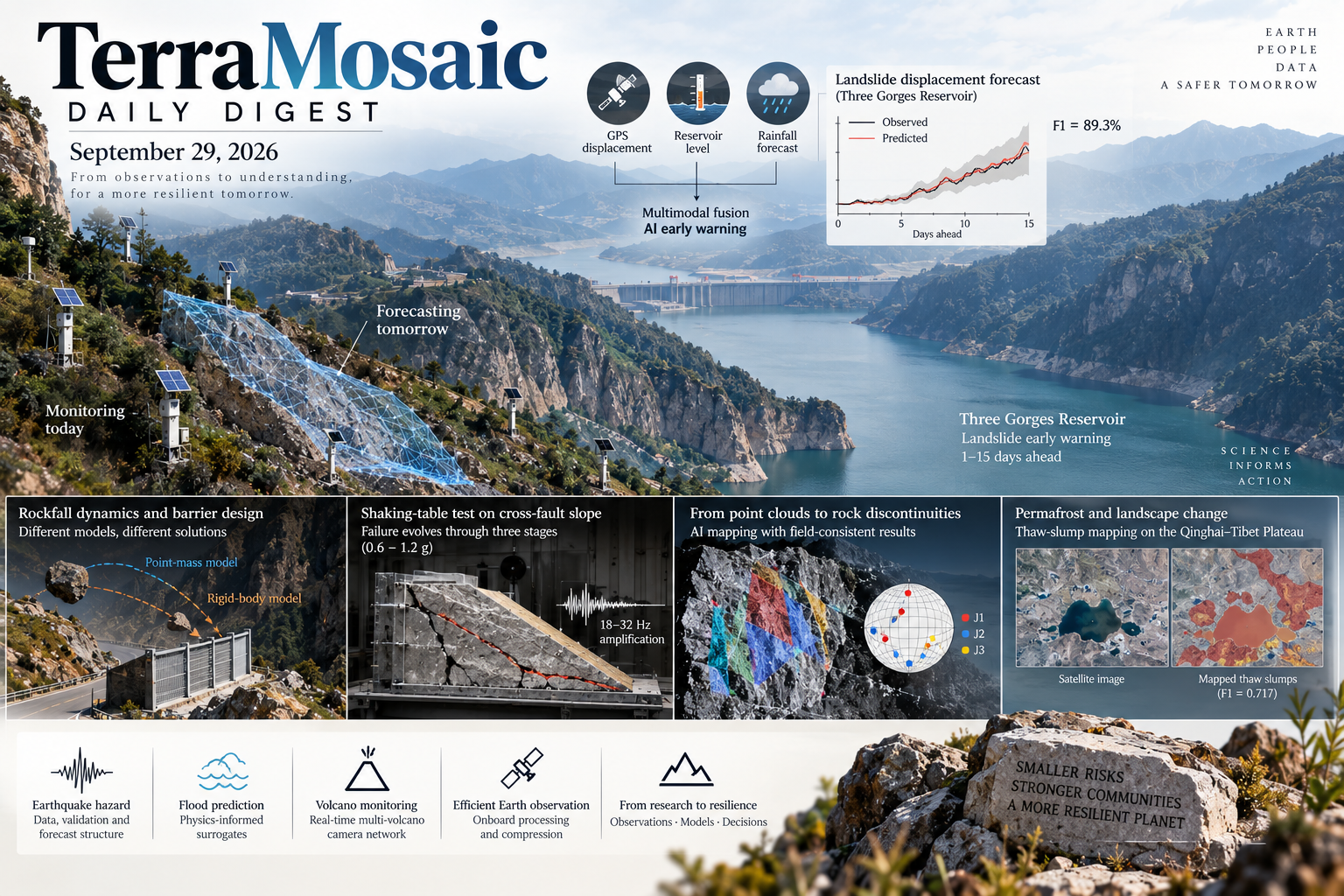
Landslide and rockfall studies tie hazard estimates to monitoring data and field evidence. In the Three Gorges Reservoir, a multimodal model that fuses GPS displacement, reservoir level and reconstructed rainfall forecasts landslide displacement 1-15 days ahead and drives a four-level warning scheme, with a short-term warning F1 score of 89.3%. A rockfall case study in Qingtian shows that point-mass and rigid-body models agree on shape-ranked block mobility yet imply different barrier designs, and neither reaches the field-mapped historical deposits. Title-level records cover the 2022 Jiujiawan mudstone landslide and road-network resilience under rainfall-induced landslides; their findings are not inferred.
Slope and permafrost studies resolve failure through staged or structural evidence. In a shaking-table test on a 30° cross-fault slope, fault dislocation amplifies 18-32 Hz signals and failure progresses through three stages between 0.6 and 1.2 g. A prior-guided network maps rock discontinuities from colored point clouds of an open-pit slope, with orientations and failure modes that agree with field observations. On the Qinghai-Tibet Plateau, a benchmark of deep-learning models for thaw-slump mapping finds that a fine-tuned Segment Anything model retains an F1 score of 0.717 at an independent site without further training.
Earthquake studies examine how data collection, validation design and forecast structure shape hazard estimates. The appropriate correction for preferentially sampled liquefaction case histories depends on how the data were actually collected. A neural ground-motion model is trained and tested on NGA-West3 records partitioned by earthquake, and single-station spectral-ratio inversion at 66 KiK-net stations recovers shear-wave velocity profiles without prior information at sites whose upper-30-m velocity is below about 600 m/s. A theoretical preprint defines a triggering-core size that separates aftershock forecasts dominated by one recent event from those supported by long histories.
Flood, volcanic and Earth-observation studies emphasize physical controls and operational constraints. In a preprint, a terrain-based physics adapter reduces the three-shot root-mean-square error of coastal-flood surrogates by 11.5-22.9% relative to matched configurations, and hindcasts show that the extreme rainfall preceding the May 2019 Arkansas River floods was predictable about two weeks ahead. A camera network developed over 32 years at Etna, Stromboli and Vulcano quantifies eruptive parameters in real time, while preprints on onboard damage assessment and planetary feature fields reduce what satellites must transmit or store.
Key Trends
The strongest papers anchor hazard estimates in field evidence, resolve damage into measurable stages and treat data collection as part of inference.
- Hazard models are checked against monitoring and field evidence: Reservoir-landslide warning uses deformation-stage thresholds, rockfall simulations are compared with mapped deposits, and point-cloud discontinuity mapping is tested against field observations of orientation and failure mode.
- Damage is resolved into stages with measurable thresholds: Cross-fault slope cracking advances through three stages between 0.6 and 1.2 g, coal-burst analysis derives critical stresses for four damage nodes, and sandstone freeze-thaw damage intensifies above about 50% saturation.
- Data collection and screening are treated as part of inference: Liquefaction corrections must match how case histories were sampled, ground-motion records are partitioned by earthquake, and a preprint finds that strict signal-to-noise screening of seismic training data gives no consistent benefit.
- Physical structure enters through architecture and guidance: In three preprints, a coastal-flood adapter builds in terrain elevation, a nowcasting model is guided by a frozen advection forecast, and a reduced representation keeps learned flows divergence-free by construction.
- Earth observation is designed around link, storage and compute budgets: Preprints downlink only onboard damage products, compress Earth-observation features about 1,800-fold and adapt a compact onboard model with fewer labels; counting every transmitted bit, however, a learned SAR coder loses to block-adaptive quantization.
Selected Papers
Three Gorges landslide early warning, cross-fault slope shaking tests, rockfall barrier design, rock-slope discontinuity mapping and liquefaction case-history sampling lead this issue. Title-level and supplementary landslide records, earthquake, flood, volcanic and underground studies follow, with Earth-observation and physics-informed methods included where they bear directly on hazard analysis.
1. Multi-Scale Landslide Displacement Prediction and Multi-Level Early Warning for the Three Gorges Reservoir Area Using Multi-Source Sensing and Gated-Attention Multimodal Fusion
Core Problem: Early warning for Three Gorges Reservoir landslides driven by reservoir-level fluctuation and short rainstorms is limited by coarse rainfall representation, static multimodal fusion and the lack of deformation-stage-based warning levels.
Key Innovation: The study fuses GPS displacement, reservoir level, rain-gauge, radar and forecast rainfall records from multiple sites (2007-2024) through PSO-Kriging rainfall reconstruction, BiLSTM-attention features and gated-attention fusion for 1-15 d displacement forecasts linked to a four-level warning scheme based on five-stage creep theory; 1 d RMSE is 3.42 ± 1.27 mm and warning F1 reaches 89.3% (short term) and 81.7% (medium to long term).
2. Damage characteristics and seismic wave propagation of cross-fault slopes based on shaking table test
Core Problem: How seismic energy transmission differs between hanging wall and footwall and controls progressive failure of slopes crossed by faults during dislocation is poorly understood.
Key Innovation: A shaking-table test on a 30° cross-fault slope, analyzed with the Hilbert-Huang transform, shows height-dependent frequency response, dislocation-driven amplification of 18-32 Hz energy and three failure stages: damage accumulation (0.6-0.7 g), inward crack propagation (0.8-0.9 g) and through-going cracking with block failure (1.0-1.2 g).
3. Rockfall Hazard Assessment and Flexible Barrier Design for Steep Forested Rock Slopes Using Rockyfor3D and RAMMS::ROCKFALL: A Case Study in Qingtian, Zhejiang Province, China
Core Problem: Point-mass and rigid-body rockfall models represent block shape, impacts and forest retardation differently, which can change predicted hazard extent and protection requirements on steep forested rock slopes.
Key Innovation: On a LiDAR-derived terrain model of a forested slope in Qingtian, Rockyfor3D and RAMMS::ROCKFALL agree on shape-ranked block mobility but diverge in kinetic energy, bounce height, lateral spread and implied barrier rating; neither trajectory envelope reaches the three field-mapped historical deposition zones (minimum gaps 61.1 m and 40 m), supporting multi-model, field-checked hazard envelopes.
4. Accurate and Integrated Detection of Interwoven Discontinuity Traces and Planes in Rock Masses via a Multimodal Prior-Guided Automated Method
Core Problem: Rock-mass investigations still struggle to detect discontinuity traces and planes together, and accurately, where they interweave in complex rock masses.
Key Innovation: The study proposes a multimodal prior-guided point-based network for colored point clouds with adaptive downsampling and multiscale aggregation; on an open-pit rock slope it matches manual annotation, and derived orientations and failure-mode assessments agree with field observations.
5. Methods for Addressing Preferential Sampling in Semiempirical Liquefaction Modeling
Core Problem: Case-history datasets for semiempirical liquefaction models are preferentially sampled, potentially biasing parameter estimates and predicted risks.
Key Innovation: The study uses Monte Carlo simulation and theory to compare no adjustment, standard weighted likelihood and balanced-weight likelihood; the appropriate adjustment depends on the actual data-collection mechanism and default case weights can be non-conservative, so the authors propose estimating inverse-inclusion-probability weights from an auxiliary dataset when that mechanism is unknown.
6. Integrated remote sensing and geotechnical investigations of the 2022 Jiujiawan mudstone landslide in Xining city, China: from deformation monitoring to failure mechanisms
Core Problem: Title-level focus: The deformation history and failure mechanism of the 2022 Jiujiawan mudstone landslide in Xining, China, are examined.
Key Innovation: Title-signalled contribution: Integration of remote-sensing deformation monitoring with geotechnical investigation, linking the observed deformation of the 2022 Jiujiawan mudstone landslide to its failure mechanisms. Methods, results and validation could not be assessed from a reliable abstract.
7. Generative modeling and reinforcement learning for road network resilience optimization under rainfall-induced landslides
Core Problem: Title-level focus: Road networks exposed to rainfall-induced landslides need resilience optimization.
Key Innovation: Title-signalled contribution: Combining generative modeling with reinforcement learning to optimize road network resilience under rainfall-induced landslides. Methods, results and validation could not be assessed from a reliable abstract.
8. Image-projected apparent particle size distribution estimation in rock avalanches using direct deep regression from UAV imagery
Core Problem: Title-level focus: Apparent (image-projected) particle size distributions in rock avalanches are estimated from UAV imagery.
Key Innovation: Title-signalled contribution: Direct deep regression of image-projected apparent particle size distribution in rock avalanches from UAV imagery. Methods, results and validation could not be assessed from a reliable abstract.
9. A Comparative Analysis of Deep Learning Models for Automated Mapping of Permafrost Thaw Slumps on the Qinghai-Tibet Plateau
Core Problem: Automated mapping of rapidly expanding retrogressive thaw slumps on the Qinghai-Tibet Plateau lacks a systematic comparison of deep-learning models.
Key Innovation: The study benchmarks five segmentation architectures with 25 backbones; a Segment Anything model fine-tuned with low-rank adaptation (ViT-H) performs best (F1 0.765, IoU 0.681) and retains F1 0.717 at an independent thaw-slump site without further fine-tuning, while PSPNet-DenseNet161 delineates boundaries more precisely.
10. Bayesian optimization of submarine landslide parameters for the 2020 Alaska Sand Point tsunami
Core Problem: Title-level focus: The submarine landslide parameters behind the 2020 Sand Point, Alaska tsunami are estimated.
Key Innovation: Title-signalled contribution: Bayesian optimization of the submarine landslide parameters behind the 2020 Alaska Sand Point tsunami. Methods, results and validation could not be assessed from a reliable abstract.
11. Ensemble Learning-Based Impact-Load Severity Appraisal for Offshore Wind Cables Exposed to Submarine Landslide Flows
Core Problem: Offshore wind cables crossing submarine landslide or density-flow paths need rapid screening of the conditions that produce severe drag and lift loads.
Key Innovation: A leakage-controlled ensemble-learning workflow with source-grouped cross-validation predicts peak drag and lift from multi-source impact data and combines them into a severity index (binary ROC-AUC 0.947; four-class accuracy 0.748); the authors present it as a screening tool rather than a design-load or risk estimate.
12. A novel building-level landslide risk assessment under rapid urban expansion: integrating high-resolution satellite data and socio-economic data using GIS for Nongpoh Planning Area, Meghalaya
Core Problem: Title-level focus: Building-level landslide risk is assessed under rapid urban expansion in the Nongpoh Planning Area, Meghalaya.
Key Innovation: Title-signalled contribution: GIS integration of high-resolution satellite data and socio-economic data for building-level landslide risk assessment. Methods, results and validation could not be assessed from a reliable abstract.
13. SA-LSN: A Self-Attentive lightweight segmentation network for road landslide
Core Problem: Title-level focus: Road landslides are segmented with a lightweight self-attentive network.
Key Innovation: Title-signalled contribution: SA-LSN, a self-attentive lightweight segmentation network for road landslides. Methods, results and validation could not be assessed from a reliable abstract.
14. Three-dimensional Slope Stability Evaluation Under Seismic Load: A Case Study in Balaroa, Central Sulawesi, Indonesia
Core Problem: The study tests whether three-dimensional seismic slope-stability analysis reproduces the massive mass movement at Balaroa during the 2018 Mw 7.4 Palu earthquake.
Key Innovation: Plaxis 3D limit-equilibrium factor-of-safety maps fall from 2.07-4.46 under static conditions to 0.66-0.90 with the Palu seismic coefficient, in relative agreement with the observed mass movement (abstract published in Arabic).
15. Review on the applications of electromagnetic method in landslide geohazard investigation
Core Problem: Ground, airborne and semi-airborne electromagnetic methods for landslide and geohazard investigation need a consolidated assessment.
Key Innovation: The review covers electromagnetic forward modeling, data processing, imaging and inversion for landslide investigation, with typical cases and instruments, and outlines directions toward deeper detection, higher-resolution imaging and full-space exploration.
16. Full-scale experimental investigation of rockfall impact on EPS geofoam-cushioned composite vertical rigid barriers
Core Problem: Title-level focus: The rockfall-impact performance of EPS geofoam-cushioned composite vertical rigid barriers is tested at full scale.
Key Innovation: Title-signalled contribution: Full-scale rockfall impact experiments on EPS geofoam-cushioned composite vertical rigid barriers. Methods, results and validation could not be assessed from a reliable abstract.
17. Influence mechanism of particle friction characteristics on seepage-induced erosion behavior of gap-graded granular systems based on CFD-DEM simulation
Core Problem: Title-level focus: Particle friction characteristics influence seepage-induced erosion of gap-graded granular systems, examined with coupled computational fluid dynamics-discrete element (CFD-DEM) simulation.
Key Innovation: Title-signalled contribution: CFD-DEM simulations examining how particle friction characteristics influence seepage-induced erosion in gap-graded granular systems. Methods, results and validation could not be assessed from a reliable abstract.
18. A Model-Agnostic Physics-Guided Adapter for Few-Shot Transfer of Coastal Flood Prediction Models to Unseen Regions
Core Problem: Deep-learning coastal flood surrogates need many costly hydrodynamic simulations before they can be fine-tuned for each new coastal region.
Key Innovation: The preprint adds a model-agnostic Physics Adapter that blends a differentiable wet/dry peak-water-level prediction (terrain versus a learned water level) with a data-driven branch through a learned gate. With three target samples, averaged over 12 backbones and transfer settings, the adapter lowers root-mean-square error by 11.5% (head-only), 15.4% (with parameter-efficient fine-tuning) and 22.9% (full fine-tuning) relative to matched configurations without it.
19. Geomechanical Evaluation and Disaster Risk Assessment of Fault Cemented Broken Rock Strata: A Comprehensive Analysis Using Unascertained Measurement and Information Entropy
Core Problem: Cemented broken rock in fault zones governs rock-mass stability and can act as a groundwater seepage channel, yet its disaster potential in deep mines has not been quantified with multiple indices.
Key Innovation: The study reconstructs fault cemented broken rock from the F1 fault zone of the SanShan Island gold mine with varied gradation, cement content and compaction stress, then combines seven indices in an entropy-weighted unascertained measurement model; gradation controls porosity and wave velocity, cement content controls strength, and risk peaks in the fault core.
20. A Quantitative Criterion for Describing Roadway Coal Burst Evolution in Deep High-Gas Coal Seams: From Initial Softening to Final Instability
Core Problem: Predicting coal bursts in deep gassy seams requires identifying critical stresses at successive damage stages of roadway-surrounding rock.
Key Innovation: The study derives analytical critical stresses for four damage nodes using a tension-shear damage weight factor that accounts for gas and temperature, verified with COMSOL; stress anisotropy, heterogeneity and cornered roadway geometry lower the critical stresses.
21. A data-driven ground-motion model for Fourier amplitude spectra of shallow crustal earthquakes using the NGA-West3 database
Core Problem: Ground-motion models for Fourier amplitude spectra must capture cross-frequency correlation and handle partially observed spectra without data leakage.
Key Innovation: The study trains a multi-output artificial neural network on the NGA-West3 ground-motion database shallow crustal records predicting effective amplitude spectra at 22 frequencies from six source, path and site predictors, using a masked loss and event-level partitioning; spectra are smooth and physically plausible.
22. Estimating S-wave velocity profiles from single-station horizontal-to-vertical spectral ratio inversion without prior information: application for KIK-NET accelerometric stations
Core Problem: Many strong-motion stations lack measured shear-wave velocity profiles because borehole surveys are costly.
Key Innovation: The study inverts single-station horizontal-to-vertical spectral ratios (HVSR) of strong-motion records, assuming vertically incident body waves, without prior subsurface information; at 66 KiK-net stations it recovers Vs profiles reliably for Vs30 (time-averaged shear-wave velocity of the upper 30 m) up to about 600 m/s, Vs30 error is below 20% at most stations, and a shallow Vs5 constraint improves stiffer sites.
23. Geospatial variation of surface ground motion parameters using the 1-D Site-Specific Seismic Ground Response Analysis (SSGRA) for Coimbatore city, Tamil Nadu, India
Core Problem: Seismic design in Coimbatore requires surface ground-motion parameters and their spatial variability, which depend on local site response.
Key Innovation: The study performs 1-D nonlinear and equivalent-linear ground response analyses at 40 boreholes in Coimbatore using spectrally matched motions and Vs30 from multichannel analysis of surface waves for 475- and 2475-year return periods, mapping spatial variation of peak ground acceleration and amplification.
24. Effects of Bulk Poroelasticity on Repeating Earthquake Sequences: Insights From Numerical Modeling
Core Problem: Most earthquake-cycle models neglect or oversimplify how slip-induced pore-pressure changes in surrounding rock feed back on fault strength and recurrence.
Key Innovation: The study simulates repeating earthquakes on a rate-and-state fault, modeled as a leaky shear zone in a 2D poroelastic medium; mean shear-zone pore pressure reproduces the stabilizing undrained limit, maximum pore pressure adds weakening and seismic slip, and one-sided pore pressure gives more complex ruptures with less seismic slip.
25. Seismic response reduction for fault-crossing continuous beam bridges using a hybrid energy dissipation system
Core Problem: Permanent fault displacement imposes high deformation and self-centering demands on bridges crossing active faults.
Key Innovation: Nonlinear time-history analyses compare rocking self-centering piers, shape-memory-alloy (SMA) friction-pendulum bearings and their hybrid on a continuous girder bridge; the piers raise yield curvature by about 31.6%, the bearings cut maximum sliding by about 35-40%, and the hybrid reduces key-pier residual displacement by about 30%.
26. Hysteretic behavior prediction of post-earthquake damaged reinforced concrete columns using machine learning
Core Problem: Residual seismic capacity of earthquake-damaged reinforced concrete columns is difficult to estimate quickly for post-event assessment.
Key Innovation: The study builds a 1053-specimen reinforced-concrete column database, simulates pre-damaged hysteresis with a calibrated modified Ibarra-Medina-Krawinkler model and trains six machine-learning models over 1000 random splits; XGBoost performs best, is checked on three external specimens, and SHAP feature attribution ranks initial damage as most influential.
27. Finite-Horizon Triggering Cores of Earthquake Sequences
Core Problem: Total-rate aftershock forecasts do not reveal whether predicted triggering rests on one recent earthquake or many dispersed past events, which affects persistence and uncertainty sensitivity.
Key Innovation: The preprint defines the finite-horizon triggering core size, the minimum number of past earthquakes carrying a fraction p of future triggering potential, and develops its theory for marked Hawkes and epidemic-type aftershock sequence (ETAS) processes; as p approaches 1 the core grows as a power law under Omori memory and only logarithmically under exponential memory.
28. How Predictable Was the Extreme Precipitation Preceding the May 2019 Arkansas River Floods?
Core Problem: Whether the extreme rainfall behind the May 2019 Arkansas River floods, and the associated atmospheric rivers, was predictable weeks in advance is unclear.
Key Innovation: The study analyzes SHiELD ensemble hindcasts and finds both atmospheric rivers and extreme precipitation predictable at about two-week leads; better-performing members developed a North Pacific Rossby wave train that favored downstream atmospheric-river conditions.
29. Ground-Based Camera Network at Active Sicilian Volcanoes: Technical Improvements and Real-Time Extraction of Eruptive Parameters
Core Problem: Operational volcano observatories need continuous, quantitative, real-time descriptions of eruptive activity to issue timely civil-protection warnings.
Key Innovation: The study documents 32 years of development of the thermal and visible camera network on Etna, Stromboli and Vulcano, with in-house real-time image analysis that detects eruptive scenarios and quantifies explosion intensity, lava-fountain mass eruption rate and column height, and fumarolic change.
30. Secondary “distal lahars” after the ~4.2 ka BP Cerro Blanco Plinian eruption, Argentina: implications for source parameter estimation and volcanic hazard assessment
Core Problem: Remobilization of distal tephra by secondary mass flows can bias eruption volume estimates and hazard assessment.
Key Innovation: Facies analysis of distal deposits of the about 4.2 ka BP Cerro Blanco Plinian eruption indicates that secondary distal lahars were the dominant remobilization mechanism, so the eruption volume and its VEI-7 classification may warrant revision.
31. Three-Dimensional Heterogeneous Structures of Newly Formed Wind Slabs and its Implications for Avalanche Release
Core Problem: The three-dimensional internal structure of newly formed wind slabs, a major cause of dry slab avalanches, is poorly observed and often assumed homogeneous.
Key Innovation: X-ray micro-computed tomography of wind-slab samples from Mt. Niseko Annupuri (2024-2025) reveals band-like three-dimensional density heterogeneity in both years; with two blizzard-related avalanches, the authors argue that such structure may affect fracture initiation and release even without a distinct weak layer.
32. Sinkhole susceptibility and genesis at the southwestern slope of the Mount Sirino (Basilicata, Southern Italy): insights from field survey and machine learning modeling
Core Problem: Lake Sirino in Basilicata, formed on a large landslide deposit, is frequently affected by piping-related sinkholes whose genesis requires explanation.
Key Innovation: Field and geomorphological surveys with remote sensing identify ten natural sinkholes linked to deep-seated piping in detrital deposits over low-permeability substrate; a MaxEnt susceptibility map over about 100 km² ranks lithology and fault density as the main predisposing factors.
33. Exploring the relationship between anthropogenic sinkholes and underground cavities in the urban area of Rome: a comprehensive evaluation of sinkhole hazard
Core Problem: Collapses of undocumented underground cavities and utility networks make anthropogenic sinkholes a major urban geohazard in Rome.
Key Innovation: The study draws on an inventory of more than 4,500 events since the early twentieth century and successive susceptibility maps; annual counts often exceeded 100 after 2012 and peaked at 175 inside the ring road in 2018, a trend the authors correlate with intense rainfall and flooding.
34. Monitoring and Analysis of Surface Deformation in Lingshi County Using Dual-Orbit LuTan-1 SBAS-InSAR
Core Problem: Single-orbit, medium-resolution InSAR cannot provide full-coverage deformation monitoring over rugged, coal-mined Loess Plateau terrain.
Key Innovation: Ascending and descending L-band LuTan-1 SBAS-InSAR (July 2023 to September 2025) maps 223 deformation zones covering 66.64 km² in Lingshi County, raises coverage to 98.91% by removing layover and shadow gaps, links over 90% of deformed area to underground mining, and is confirmed for 95.96% of anomalies by field and UAV checks.
35. PyroStack: A Multi-Band Spatio-Temporal Sub-Daily Dataset for Wildfires in the United States
Core Problem: Existing wildfire datasets lack the resolution and coverage to capture interacting weather, fuel, vegetation and terrain controls on fire spread.
Key Innovation: The preprint harmonizes satellite fire observations with reanalysis, vegetation, fuel and topographic data for 6,994 wildfires in the contiguous United States and Alaska (2012-2024) at 30 m to 9 km and hourly resolution, with 12-hour progression data for initializing and benchmarking physics-based and machine-learning spread models.
36. Embedded Bi-Temporal Building Damage Assessment for On-Board Data Reduction
Core Problem: Rapid satellite-based building damage assessment after disasters is limited by uplink/downlink capacity and ground-processing latency.
Key Innovation: A siamese YOLOX-derived detector compares compressed (up to 64×) uplinked pre-event latents with onboard post-event imagery and downlinks only damage boxes and classes; a latent shift-correction module improves robustness to co-registration errors on xBD. The pipeline runs on Versal and Jetson hardware, although the shift-correction operators run only on the Jetson.
37. Multi-Sensor Change Detection in Flood Monitoring: A Reliability-Aware Dual-Regularized Fusion Network
Core Problem: Title-level focus: Multi-sensor flood change detection must account for differences in sensor reliability.
Key Innovation: Title-signalled contribution: A reliability-aware, dual-regularized fusion network for multi-sensor change detection in flood monitoring. Methods, results and validation could not be assessed from a reliable abstract.
38. Optimization of rock bolt support parameters for TBM tunnels in high in situ stress soft rock based on deformation and stress evolution analysis
Core Problem: Large squeezing deformation of soft rock under high in situ stress during deep tunnel-boring-machine (TBM) tunneling can cause support failure and machine jamming.
Key Innovation: The study uses a 3D ABAQUS model of a deep TBM tunnel in Southwest China to evaluate bolt length, spacing and prestress; much deformation develops ahead of the face, gains saturate beyond about 9 m length and 150 kN prestress, and a support scheme is recommended.
39. Dynamic response and failure characteristics of surrounding rock in existing tunnel under transient excavation of adjacent tunnel
Core Problem: Title-level focus: Transient excavation of a new adjacent tunnel can induce dynamic loading and damage in the surrounding rock of an existing tunnel.
Key Innovation: Title-signalled contribution: An analysis of dynamic response and failure characteristics of the existing tunnel's surrounding rock under transient excavation of an adjacent tunnel. Methods, results and validation could not be assessed from a reliable abstract.
40. Quantitative analysis of seismic energy balance and dissipation in soil-structure interaction systems
Core Problem: Title-level focus: Seismic energy balance and dissipation in soil-structure interaction systems are quantified.
Key Innovation: Title-signalled contribution: A quantitative analysis of seismic energy balance and dissipation in soil-structure interaction systems. Methods, results and validation could not be assessed from a reliable abstract.
41. Study on mechanical breakage mechanisms of volcanic soil particles under discrete element method
Core Problem: Porous volcanic soil particles crush easily, yet how breakage controls the soil's bulk mechanical behavior is not well understood.
Key Innovation: The study calibrates discrete-element (DEM) fragment-replacement simulations with single-particle crushing tests, showing a size effect on crushing strength, more sliding contacts and lower coordination number with breakage, and suppressed fabric anisotropy.
42. Seismic Versus Sub-Seismic Experimental Mirror-Like Fault Surfaces in Bituminous Dolostones
Core Problem: Mirror-like carbonate fault surfaces form at both seismic and sub-seismic slip rates, complicating their use as indicators of past earthquake slip.
Key Innovation: Rotary-shear experiments on bituminous dolostone produced mirror-like surfaces under all tested conditions, and bitumen lowered friction. Under room humidity, seismic surfaces showed micro-cracks and flat nanoparticle aggregates while sub-seismic surfaces showed sub-spherical aggregates, which may help distinguish the two in natural faults.
43. Metaheuristic-based optimization of steel space truss roof structures with seismic isolation
Core Problem: Optimizing space truss roofs under near-fault and far-fault ground motions with isolation requires efficient automated search.
Key Innovation: The study couples SAP2000 and MATLAB to compare Rao-family algorithms with teaching-learning-based optimization under bi-directional nonlinear time-history loading; Rao-1 matches the minimum weights with about 51% less run time, near-fault motions raise local demands, and isolation lowers optimized weights to 47.4% of the fixed-case maximum.
44. Multi-source data integration for soil parameter uncertainty quantification
Core Problem: Calibrating soil parameters is hindered by sparse measurements, model discrepancy, correlated outputs and heterogeneous data types.
Key Innovation: The study combines PCA-polynomial chaos surrogates with a custom multi-source likelihood accounting for model discrepancy and spatial weighting in staged Bayesian updating; demonstrated on a full-scale laterally loaded pile test with systematic uncertainty reduction.
45. Dynamic Identification of Layered Interfaces and Defect Zones for Tunnel-Ahead Geological Prediction Using Percussion-Rotary MWD Data and an MOE-Transformer Model
Core Problem: Conventional tunnel-ahead prediction of interfaces and defect zones has coarse resolution, discontinuous coverage and heavy reliance on expert interpretation.
Key Innovation: The study uses percussion-rotary measurement-while-drilling data with a mixture-of-experts Transformer on laboratory specimens, reaching 98.12% strength-grade accuracy and reconstructing interface planes within about 2° of theoretical orientation.
46. Experimental and Theoretical Investigations on the Pore Water Freezing and the Critical Degree of Saturation for the Unsaturated Sandstone Based on the In Situ Nuclear Magnetic Resonance
Core Problem: Frost damage in rock depends on water content, yet unfrozen-water evolution and critical saturation thresholds in unsaturated rock are poorly characterized.
Key Innovation: In situ low-field nuclear magnetic resonance (NMR) tracks pore-water freezing in three sandstones, showing bound water persisting at -40 °C; a frost-heave strain model is validated and freeze-thaw tests identify a critical saturation near 50%.
47. Temperature Effect Study for Grouting in Karst Conduit via a Novel Physical Simulation Approach
Core Problem: High ground temperature in deep tunnels alters flowing-water grouting used to plug karst conduits, but its effect on plugging is unclear.
Key Innovation: A visualized temperature-controlled grouting rig shows higher temperature accelerates slurry deposition, shortens plugging time by about 13% at 40 °C and 21% at 60 °C, and reduces the consolidated plug, implying denser grouting holes are needed.
48. Comparison of slip behaviour in critically stressed saw-cut granite fractures under mechanical and thermal loading
Core Problem: Title-level focus: Critically stressed fractures may slip differently under mechanical versus thermal perturbation, relevant to fault reactivation in stressed rock.
Key Innovation: Title-signalled contribution: Laboratory comparison of slip behavior in critically stressed saw-cut granite fractures under mechanical and thermal loading. Methods, results and validation could not be assessed from a reliable abstract.
49. An improved Green-Ampt infiltration model of depth-dependent initial soil water content and its experimental verification
Core Problem: Title-level focus: An improved Green-Ampt infiltration model accounts for depth-dependent initial soil water content and is verified experimentally.
Key Innovation: Title-signalled contribution: An improved Green-Ampt infiltration model incorporating depth-dependent initial soil water content, with experimental verification. Methods, results and validation could not be assessed from a reliable abstract.
50. Divergent responses of streamflow reanalysis errors to precipitation reanalysis errors modulated by catchment heterogeneity
Core Problem: How errors in precipitation reanalysis propagate into streamflow reanalysis, and how catchment properties modulate that propagation, is poorly quantified.
Key Innovation: Across 671 U.S. catchments, GloFAS v4.0 streamflow error forced by ERA5 rises by about 0.51 mm per 1 mm rise in precipitation error; the response reaches 2.5 mm in humid catchments, whereas arid catchments and snow storage damp or delay it.
51. SHELDA: sub-hourly European quality controlled sea level dataset
Core Problem: Short-period sea-level extremes are often missed because existing tide-gauge datasets lack sub-hourly resolution or adequate quality control.
Key Innovation: The study compiles 257 quality-controlled European tide-gauge records sampled every 1-15 min in NetCDF, with de-tided residuals, to support analysis of short-term sea-level variability and extreme events.
52. Climate-informed cryospheric reanalysis via hierarchical Bayesian data assimilation
Core Problem: Cryospheric reanalyses treat water years independently or fix parameters, performing poorly when snow and glacier observations are sparse and noisy.
Key Innovation: Partial-pooling hierarchical Bayesian assimilation jointly infers states, annual parameters and climatological hyperparameters via nested particle smoothing; across eight Alpine-to-Arctic sites it improves the continuous ranked probability score by 51% over the prior, versus 38% and 19% for annual and static calibration, at far lower cost than particle Markov chain Monte Carlo.
53. Does High Signal-to-Noise Ratio Identify Better Training Data for Seismic Deep Learning?
Core Problem: Hard signal-to-noise screening is routinely used to curate seismic training data, but whether cleaner waveforms compensate for discarded examples has not been tested.
Key Innovation: The preprint tests SNR screening for phase picking and ambient-noise dispersion; screening gave no consistent benefit, while retaining all eligible dispersion paths cut error by 3.0% at fixed compute, so gains depend on task, schedule and test domain.
54. Convergent representations of elastic-wave structure emerge across deliberately distinct seismic training routes
Core Problem: It is unclear whether seismic deep-learning models trained on earthquake data encode waveform structure that transfers to laboratory fracture acoustic emissions.
Key Innovation: The preprint compares a phase picker (PNSN) and a multi-task model (SeismicXM) on held-out laboratory acoustic emissions, finding representational agreement beyond matched random networks; transfer to receiver functions and noise correlations is mixed, with simple baselines remaining competitive.
55. Physics-Guided Flow-Map Matching for Precipitation Nowcasting
Core Problem: Radar nowcasting models blur rare high-intensity rainfall structures because pixel losses push predictions toward the conditional mean.
Key Innovation: PG-FMM uses a frozen Lagrangian advection prior as guidance for a conditional flow-map generative head that produces stochastic small-scale detail in four steps; on four radar benchmarks it leads on 18 of 24 metrics, with critical-success-index gains up to 58.9% at heavy-rain thresholds.
56. NowcastDiT: Diffusion Transformers are Effective Precipitation Nowcasters
Core Problem: Short-term precipitation nowcasting must capture strong spatiotemporal variability, and diffusion approaches have grown increasingly specialized.
Key Innovation: The preprint shows that a standard Diffusion Transformer, adapted with a dynamics-aware noise prior and reinforcement learning on timestep-aware meteorological rewards, achieves state-of-the-art perceptual quality and skill on SEVIR and MRMS radar benchmarks.
57. From Wildfire Severity to Snow Persistence: A Multisource GeoAI Study of the 2020 Creek Fire
Core Problem: High predictive accuracy for post-fire snow conditions does not separate wildfire effects on snow persistence from terrain and climate controls.
Key Innovation: The preprint combines HLS-derived snow persistence (2016-2026, 500 m) with matched burned-unburned before-after-control-impact comparisons and explainable XGBoost for the 2020 Creek Fire; the landscape-average effect is near zero, persistence rises 2.6 percentage points in the highest burn-severity class, and skill for the fire-adjusted anomaly is low (R² 0.046).
58. GeoSET: Generalist Foundation Model for SAR-to-EO Image Translation
Core Problem: SAR-to-optical image translation models are trained on single limited datasets and generalize poorly across sensors, resolutions and regions.
Key Innovation: GeoSET pretrains a conditional generator with a speckle-robust SAR encoder on over 3 million curated SAR-optical image pairs, then adapts via low-rank adaptation (LoRA) (0.60% of parameters, about one hour per dataset), reporting state-of-the-art image-quality scores (FID and DISTS) on six downstream benchmarks.
59. Planetary Feature Fields are Scalable Earth Representations
Core Problem: Satellite observations, precomputed embeddings and map products are stored as separate petabyte-scale archives, making compact multi-product access with spatial and temporal detail costly.
Key Innovation: Planetary Feature Fields jointly model multiple Earth-observation (EO) products as hybrid explicit-implicit neural fields sharing a factored feature volume; at 1,800-fold compression they retain approximately 90% or more of original-feature performance on segmentation, change detection and classification, and cut feature-access latency about tenfold.
60. HyperSAM: A Promptable Foundation Model for Hyperspectral Remote Sensing
Core Problem: General-purpose hyperspectral foundation models are limited by scarce high-resolution annotated cubes and little reuse of priors from modern vision foundation models.
Key Innovation: The preprint couples physics-informed synthesis of hyperspectral cubes from SpaceNet multispectral imagery and SAM3 pseudo-masks with a SAM3-based architecture adding a trainable hyperspectral side encoder and noisy-label weighting; reports generalization across classification, anomaly, change and target detection and airborne oil-spill mapping.
61. PoE-Fuse: Precision-Weighted Expert Fusion for Bi-Temporal Change Understanding
Core Problem: Adapting vision-language models to satellite change detection, building localization and damage assessment usually requires costly and unstable full fine-tuning or reinforcement learning.
Key Innovation: PoE-Fuse fuses frozen geometry, grounding and language experts on a shared grid through learned per-cell precision (product of experts), training only a lightweight trunk; one model handles three tasks with mean F1 59.2% versus 40.7% for a temporal VLM assistant.
62. HydroDrone: A Circular External-Looking UAV-SAR Campaign for Short-Term Temporal Decorrelation Characterization
Core Problem: Title-level focus: Short-term temporal decorrelation is characterized with a circular, external-looking UAV-SAR campaign (HydroDrone).
Key Innovation: Title-signalled contribution: A circular, external-looking UAV-borne SAR campaign (HydroDrone) designed to characterize short-term temporal decorrelation. Methods, results and validation could not be assessed from a reliable abstract.
63. Determining the optimal focusing parameter in sparse promoting inversions of EMI surveys
Core Problem: Smooth Tikhonov-regularized electromagnetic induction (EMI) inversions cannot recover sharp subsurface conductivity boundaries, and sparsity-promoting norms need a focusing parameter that is hard to choose.
Key Innovation: The study proposes an L-curve-based, prior-free rule for selecting the focusing parameter of minimum-gradient-support and Cauchy measures; validated on synthetic and new field EMI data, with the Cauchy measure performing at least as well as minimum gradient support.
64. SCOPE: Observation-Conditioned Full-Target Prediction for Sparse PDE Inference
Core Problem: Recovering complete physical fields from sparse measurements is ill-posed; diffusion solvers are slow and neural operators trade accuracy for deterministic speed.
Key Innovation: SCOPE couples full-field latent prediction with a shared physical decoder and derives a risk decomposition showing why optimal latent prediction need not give optimal field reconstruction; it beats mask-aware neural operators on all ten forward/inverse tasks across five PDE settings and reports lower errors than published DiffusionPDE and FunDPS results.
65. Preconditioned Physics-Informed Neural Operator Training
Core Problem: Physics-informed training of neural operators is ill-conditioned by differential operators, worsening with mesh refinement and trailing supervised training in accuracy.
Key Innovation: The preprint introduces a multigrid-preconditioned residual loss with mesh-independent conditioning for elliptic problems, agnostic to architecture and free at inference; on Poisson, Allen-Cahn and Stokes equations, label-free training matches supervised training and is 4-25 times more accurate than prior physics-informed operator methods.
66. Data-Efficient Time-Dependent PDE Surrogates: Graph Neural Simulators vs. Neural Operators
Core Problem: Neural operators used as PDE surrogates need large training sets and accumulate error in long autoregressive rollouts.
Key Innovation: The preprint evaluates graph neural simulators that learn instantaneous time derivatives with numerical time-stepping against DeepONet, FNO and GINO on five PDEs including nonlinear shallow water; reports sub-1% error with 3% of trajectories and much lower rollout error than FNO.
67. SINO: Scale-Invariant Neural Operator
Core Problem: Coarse-grid PDE solvers need closure models for unresolved physics, and neural operators tend to memorize grid-specific patterns rather than scale-invariant laws.
Key Innovation: SINO learns on normalized physical scales with a dual spectral-spatial branch and low-rank continuous kernels generated by bottleneck MLPs; on Burgers, Kuramoto-Sivashinsky and Navier-Stokes turbulence closure benchmarks it reports 1.5-38× lower error and 2-23× better parameter efficiency than baselines.
68. KernelOnet: An Interpretable Neural Operator Based on Kernel Functions
Core Problem: Standard neural operators learn basis functions implicitly, limiting interpretability and requiring interior solution data for training.
Key Innovation: KernelOnet replaces the DeepONet trunk with explicit learnable, physics-informed (fundamental-solution) or hybrid kernels; it reaches high accuracy with fewer parameters on benchmarks and a shallow-water acoustic waveguide, and the physics-informed variant trains from boundary conditions alone.
69. Learning in the Transverse Subspace: A Minimal Representation for Divergence-Free Operator Learning
Core Problem: Redundant potential parameterizations of divergence-free fields yield non-unique states, hindering neural-operator learning of incompressible flow dynamics.
Key Innovation: The preprint encodes a D-component divergence-free field as an invertible (D-1)-component field via a Fourier-space Householder transform, so neural operators evolve flows in reduced coordinates; this lowers temporal-prediction error and improves robustness without post-hoc projection, while redundant potentials still ease static fitting.
70. Modelling heterogeneous human mobility patterns during emergencies using archetypes
Core Problem: Title-level focus: Heterogeneous human mobility patterns during emergencies are modeled with archetypes.
Key Innovation: Title-signalled contribution: An archetype-based approach to modeling heterogeneous human mobility patterns during emergencies. Methods, results and validation could not be assessed from a reliable abstract.
71. Long-Term Stability of Salt Caverns for Hydrogen Storage Considering Deliquescence-Creep Coupling Behavior
Core Problem: Humidity-driven deliquescence of rock salt may accelerate time-dependent deformation and threaten long-term stability of hydrogen storage caverns.
Key Innovation: The study couples a gridpoint-displacement deliquescence simulation with a time-dependent-damage elasto-visco-plastic creep model for the Jintan salt cavern; creep dominates long-term convergence, but coupling raises 50-year gas-volume shrinkage from 7.67% to 8.28% and enlarges low safety-factor zones.
72. Managed aquifer recharge in confined multi-layer aquifers: a scalable framework for drought resilience in central Europe
Core Problem: Water-stressed regions need scalable ways to store surplus wet-period surface water for drought use without violating ecological flow limits.
Key Innovation: The study combines standardized precipitation-evapotranspiration and groundwater index (SPEI/SGI) drought analysis, GIS multi-criteria suitability mapping and ecological-flow-constrained surface-water availability to assess aquifer storage, transfer and recovery in Berlin-Brandenburg; 62.8% of the area (2154 km²) is viable, and high-potential sites could recharge 1.6-4.3 Mm³ per year but lose 40-100% of that in severe drought years.
73. The Influence of Context in the Reach-Scale Distribution of Logjams
Core Problem: Whether channel planform and forest context control the longitudinal density and spatial clustering of logjams in subalpine mountain streams remains poorly constrained.
Key Innovation: Field survey of 17 Colorado subalpine reaches tests logjam density and spatial randomness; densities did not differ significantly between single- and multithread channels, but multithread reaches stored about twice the wood volume, with scatter linked to blowdown recruitment and flood removal.
74. Seismic Anisotropy and Lithospheric Deformation of the Eastern (Chinese) Tianshan Orogen
Core Problem: How the Tianshan lithosphere deforms during intracontinental mountain building, far from plate boundaries, remains debated.
Key Innovation: A dense broadband array (about 15 km spacing) along an about 600 km profile measures SKS/SKKS splitting; strike-parallel fast directions with delays up to 1.2 s point to pure-shear deformation of a thick orogenic lithosphere between the rigid Tarim and Junggar blocks, and an east-west comparison suggests the eastern Tianshan is still thickening while the western Tianshan shows delamination.
75. Calcium Carbonate Precipitation Visualization on a Lab-on-a-Chip Model With Spectral Induced Polarization Monitoring
Core Problem: Particle-scale growth of calcium carbonate precipitates in porous media, relevant to geomaterial strengthening and carbon storage, is rarely visualized together with geophysical signals.
Key Innovation: The study couples a microfluidic chip with optical imaging and spectral induced polarization; imaginary conductivity tracked dispersed precipitate content until aggregation, and relaxation time followed the Schwartz relationship only before clusters and precipitation bands formed.
76. Learned Compression of SAR Phase-History Data: A Rate-Honest Feasibility Study on GOTCHA
Core Problem: It is unclear whether small learned autoencoders can replace block-adaptive quantization for bandwidth-limited onboard compression of SAR phase-history data.
Key Innovation: A rate-honest comparison on AFRL GOTCHA phase history finds that a compact convolutional autoencoder loses to block-adaptive quantization (BAQ) at every rate and to a cheaper block Karhunen-Loève transform coder; most constant-false-alarm-rate detections on raw patches are border artifacts, BAQ clipping governs detection, and the authors propose an evaluation protocol.
77. EnJoi: Ensemble Joint Score Filter for Generative Data Assimilation
Core Problem: Autoregressive diffusion models for data assimilation ignore uncertainty in their own past predictions when reconstructing partially observed dynamical states.
Key Innovation: EnJoi learns the joint past-future state distribution with a score model and couples it with a modified ensemble 4DVar update; fluid and traffic-flow simulations show improved reconstruction, especially with sparse, non-homogeneous observations.
78. Physical Cross-Modal Masked Autoencoding for Seismic-to-Well Representation Learning
Core Problem: 3D seismic volumes and sparse 1D well logs differ sharply in spatial support and resolution, hindering joint representation learning for subsurface characterization.
Key Innovation: A cross-modal masked autoencoder embeds seismic volumes and well-log patches in shared physical coordinates, pretrained on 23 surveys (about 178,000 km²) and about 92,000 wells; seismic context improves held-out log reconstruction by 9.73%, and seismic-only pseudo-logs separate salt bodies (AUROC 0.910), though calibration stays survey-dependent.
79. EnergyEminence: Source-Aware Environmental Calibration and Evaluation in a Physics-Grounded Grid Digital Twin
Core Problem: Power-grid digital twins that ingest environmental alerts such as wildfire detections lack provenance-preserving calibration and evaluations that expose shortcut learning.
Key Innovation: The preprint couples a graph-temporal grid predictor with AC cascade simulation and a bounded calibration of wildfire-detection confidence and extent; from 160 scenarios built on 16 synthetic videos, a source-video-disjoint test gives 10 true positives, 8 false positives and no false negatives and exposes shortcut learning hidden by random splits. Evidence remains early-stage and synthetic.
80. Transversal Pooling Neural Networks
Core Problem: Many learning tasks need stability to small transformations but sensitivity to larger ones, which standard spatial max pooling provides only for translations.
Key Innovation: The preprint generalizes max pooling to affine group actions with subgroup equivariance and explicit stability bounds for pooled wavelet coefficients; experiments indicate utility in low-data settings and for predicting tropical cyclone intensification, although the abstract reports no quantitative results.
81. OTT3R: Multi-View 3D Reconstruction and Fast Dataset Generation at 1% Compute
Core Problem: Feed-forward 3D reconstruction models are costly to train and deploy, and neural pseudo-label generation still relies on slow, failure-prone Structure-from-Motion.
Key Innovation: The preprint distills a 959M-parameter reconstruction model into a 102M student at 1.6% of VGGT training compute and adds a pseudo-label pipeline producing dense point maps and camera poses for 667K images in 3.5 hours; the general student does not replace the teacher on out-of-distribution multi-view geometry.
82. PDE-OBS: Controlled Evaluation Across Observation Patterns
Core Problem: Field reconstruction and forecasting models are usually evaluated under one observation layout, hiding how performance degrades when sensor density or placement changes.
Key Innovation: The preprint releases PDE-OBS, 560,000 fields from seven PDE families with configurable observation operators and seven baselines; across 3,969 evaluations, cross-pattern error exceeds matched-pattern error for every PDE-method pair, and denser test observations do not reliably lower error.
83. OCA: ODE-Driven Cross-Attention for Image-to-Point-Cloud Registration
Core Problem: Cross-attention in learning-based image-to-point-cloud registration suffers from attention ambiguity, which weakens the discriminative 2D-3D correspondences that registration depends on.
Key Innovation: The preprint models ideal 2D-3D feature interaction with ordinary differential equations and builds a plug-in ODE-driven cross-attention module. Added to five baselines and tested on four public benchmarks, it raises registration recall by up to 5%, 9% and 15% in the standard, fine-tuning and zero-shot settings.
84. Graph-Spectral Flow Matching for Multivariate Time Series Anomaly Detection
Core Problem: Flow-matching anomaly detectors use linear probability paths that ignore dependencies between variables, so they fit structured multivariate sensor time series poorly.
Key Innovation: The preprint builds a graph-spectral probability path by minimizing kinetic plus graph Dirichlet energy, which gives a closed-form interpolation that depends on graph frequency. Anomalies are scored by weighted velocity discrepancies. The method is proven invariant to the choice of Laplacian eigenbasis and outperforms baselines on four benchmarks.
85. UniBuild: Unified Building Mapping From Multi-Source Optical Remote Sensing Imagery With Detail Decoding and Geometry Regularization
Core Problem: Building extraction models from optical imagery are dataset-specific, generalize poorly, and produce blurred boundaries and merged adjacent buildings.
Key Innovation: The preprint trains a unified model across 10 public high-resolution and two low-resolution RGB datasets with a detail-preserving decoder and geometry-aware boundary losses; reports sharper boundaries and generalization to unseen domains, including imagery as coarse as 10 m, with released code.
86. ZeroDiff: Zero-Shot Time Series Reconstruction via Informed-Prior Diffusion
Core Problem: Target time series are often unmeasured at many locations, and mapping exogenous inputs alone yields over-smoothed reconstructions that underestimate extremes.
Key Innovation: The preprint builds an informed prior from exogenous variables and learns diffusion-based calibration of reconstruction errors on observed locations, generalizing to unobserved ones; reports improvements over existing approaches on several real-world datasets.
87. Neural Constitutive Learning for Generalized Reaction-Diffusion Systems
Core Problem: Neural PDE solvers lack a shared interface accommodating diverse transport, reaction kinetics and multispecies coupling in reaction-diffusion systems.
Key Innovation: The preprint learns PDE-specific constitutive responses (mobility, driving force, reaction rates) while keeping time evolution in a shared mass-compression-transport integrator; across seven systems relative rollout errors of 1e-4 to 1e-2 are reported, including trajectory-free training.
88. Variational Augmented Invertible Koopman Autoencoder for probabilistic time series forecasting
Core Problem: Neural Koopman autoencoders forecast dynamical systems deterministically and cannot quantify the uncertainty of long-horizon predictions.
Key Innovation: The preprint introduces VAIKAE, a Koopman autoencoder with a Gaussian latent embedding and normalizing flows that enable likelihood-based training, plus strategies for uncertainty-aware latent data assimilation; evaluated only on standard long-term forecasting benchmarks.
89. Label Less, Learn More: Resource-Efficient Active Semi-Supervised Learning for Onboard Satellite Image Annotation
Core Problem: Onboard satellite vision is limited by annotation cost and restricted compute, memory and energy, hindering deployment of task-specific models.
Key Innovation: SatLabel couples uncertainty-, imbalance- and pseudo-label-aware sample acquisition with semi-supervised adaptation of a compact 11.2M-parameter student; across 11 remote-sensing datasets it improves Macro-F1 over RemoteCLIP zero-shot on most core and extended sets at lower compute.
90. PHASE: Multi-Regime Modeling of Incompressible Magnetohydrodynamics
Core Problem: Neural-operator surrogates for magnetohydrodynamics must be retrained for each physical regime, limiting generalization across parameter settings.
Key Innovation: PHASE combines transfer learning, regime-aware adaptation, physics-centered learning and residual error correction; on 2D MHD turbulence it reduces relative L2 errors by over an order of magnitude versus prior operators and generalizes to unseen parameters, including Kelvin-Helmholtz instability.
91. Pixel-Level Transformers in Remote Sensing: A Canopy Height Case Study
Core Problem: Patch-based Transformers underperform on pixel-level regression from medium-resolution satellite imagery, while full pixel-level attention is computationally prohibitive.
Key Innovation: The preprint benchmarks pixel-level attention and efficient attention variants for canopy height estimation, finding pixel-level schemes outperform larger patches and, with suitable hyperparameters, competing established models; provides design guidance for related tasks such as soil moisture mapping.
92. No Scale Left Behind: Multi-Scale Autoencoder with Bi-directional Attention for Time Series Anomaly Detection
Core Problem: Anomalies in monitoring time series range from sub-second spikes to multi-hour drifts, yet most detectors operate at one temporal granularity or a fixed coarse-to-fine hierarchy.
Key Innovation: The preprint uses parallel autoencoder branches with different patch sizes, linked by symmetric bidirectional cross-scale attention so every scale pair exchanges information before reconstruction; on the TSB-AD benchmark (40 datasets, 530 series) it raises the VUS-PR detection score by about 9% over the prior state of the art among 50 baselines.
93. Improving Function Space Flow Matching with Kernel Optimal Transport
Core Problem: Functional flow matching pairs prior and data samples arbitrarily, so learned bridges must carry both shared structure and instance residuals when modeling distributions over function spaces.
Key Innovation: The preprint replaces independent pairing with entropic optimal transport under a kernel-induced cost while keeping the neural-operator architecture, with well-posedness and discretization-invariance proofs; improves distributional matching over flow, diffusion and adversarial baselines on time-series and PDE benchmarks, including turbulent Navier-Stokes.
94. A foundation model for energy and radiation systems built on heterogeneous scientific interfaces
Core Problem: Scientific foundation models are typically evaluated after heterogeneous physical problems are forced into a common representation, leaving actual reuse of pretrained computation untested.
Key Innovation: The preprint couples native task-specific interfaces to a shared routed library of wavelet operators spanning flow, radiation-dose and elastoplastic-stress problems; parameter isolation preserves earlier tasks, but randomized-library controls show pretrained reuse is task- and data-dependent, and task-specific operators remain more accurate on three of five problems.
95. RS-OPSD: Reliable Privileged On-Policy-Self-Distillation for Ultra-High-Resolution Remote Sensing VQA
Core Problem: Question answering on ultra-high-resolution remote-sensing images requires finding small evidence in very large scenes, usually through costly inference-time search or tool calls.
Key Innovation: The preprint internalizes zoom-in privileged evidence through on-policy self-distillation with context-preserving crops and correctness-aligned distillation, using a new 6,750-sample evidence-annotated dataset; reports about 4-point average gains over comparable-scale models on three UHR remote-sensing VQA benchmarks without inference-time search.
96. Tensor-Train Compressed Separable PINNs: A Curvature-Aware Optimization Framework for Parametric PDEs in High Dimensions
Core Problem: Second-order optimization of physics-informed neural networks for high-dimensional parametric PDEs is prohibitive because the residual Jacobian scales with the tensor-product collocation grid.
Key Innovation: The preprint shows that coordinate-separable architectures with separable linear(ized) operators give a factorized residual Jacobian, enabling an exact compressed Gauss-Newton step under canonical-polyadic and tensor-train parametrizations; on high-dimensional parametric PDEs it reaches much lower error than tensor-compressed first-order optimizers in far fewer iterations.
97. CI-PINN: Causal Integral Physics-Informed Neural Network for Solving Evolution Equations
Core Problem: Standard physics-informed neural networks use pointwise space-time representations that do not encode temporal causality, degrading accuracy for evolution equations, especially with sparse collocation points.
Key Innovation: The preprint proposes CinNet, which embeds a Volterra-type causal integral aggregating historical features, and builds CI-PINN on it; on benchmark evolution equations it outperforms PINN variants, most clearly under sparse collocation, with low hyperparameter sensitivity.
98. Learning Nonlinear Finite Element Solution Operators using Multilayer Perceptrons and Energy Minimization
Core Problem: Repeated nonlinear finite element solves over parametrized boundary conditions and coefficients are expensive, limiting fast many-query PDE analysis.
Key Innovation: The study represents the nonlinear finite element solution operator with an MLP trained by minimizing the PDE energy functional assembled locally per element, allowing stochastic element subsampling for large meshes; evaluated on several test cases in combination with standard FEM.
99. Observation-Aligned Mask Priors for Learning Physical Fields from Authentic Occlusions
Core Problem: Learning physical fields from satellite data is hampered by structured, non-random occlusions that heuristic masking schemes used in training do not represent.
Key Innovation: The preprint learns a prior over authentic observation masks with a Bayesian Flow Network and uses guided masks to build context-query splits for a diffusion reconstructor; improves MSE and PSNR over diffusion baselines on three oceanographic satellite datasets.
100. Learning Spectrally Optimised Mesh-Free Discretisations
Core Problem: Mesh-free PDE discretizations on unstructured point clouds depend on heuristic kernels that ignore spectral accuracy across resolved wavenumbers.
Key Innovation: The preprint learns stencil weights from local point geometry with a projection layer that enforces moment consistency exactly, optimizing spectral response without supervision; the PDE-agnostic operators transfer to Poisson, Burgers and Navier-Stokes and match or beat established mesh-free schemes.
101. Marine Heat Waves and Cold Spells - Multiple Analysis/Definitions (MHW-MAD): A Multi-Definition Global Marine Heatwave Database from Satellite Sea Surface Temperature Data
Core Problem: Marine heatwave and cold-spell statistics depend strongly on baseline, threshold, detrending and duration choices, hindering consistent comparison across studies.
Key Innovation: The study releases a global 1982-2024 satellite SST database applying multiple heatwave and cold-spell definitions in parallel, enabling direct comparison of event characterization across methodological choices.
102. LSA SAF Land Surface Temperature: Evolution and Validation of Version 2 suite of Products
Core Problem: Long-term climate applications require stable, validated land surface temperature records from EUMETSAT satellite sensors.
Key Innovation: The study describes Version 2 LSA SAF land-surface-temperature products from MSG SEVIRI (0° and IODC), Metop AVHRR and an all-sky SEVIRI product with a revised calibration database, emissivity algorithm and sensor calibration; against in situ data the signed bias is 0.20, 0.21, -0.22 and 0.24 K, and all records except IODC MLSTv2 meet GCOS stability requirements.
103. Committed Antarctic Ice Sheet mass loss by the end of the twenty-first century
Core Problem: How much Antarctic Ice Sheet mass loss by 2100 is already committed, and how emissions modulate it, remains a key uncertainty for sea-level projections.
Key Innovation: The study uses a machine-learning emulator of ice-sheet model ensembles, calibrated against satellite observations, to trace how physical assumptions propagate into projection uncertainty; twenty-first-century Antarctic mass loss is very likely committed even under strong emissions cuts, and very high emissions could add up to 25.4 cm of sea-level rise by 2100 (95th percentile).
104. Correcting for spatial and temporal dependence in estimating the economic effect of extreme heat
Core Problem: Published estimates of extreme-heat effects on subnational economic growth may overstate precision by ignoring spatial and temporal dependence in panel data.
Key Innovation: The study re-examines a prior extreme-heat GDP study using country-preserving permutations, post-selection correction and a hierarchical Bayesian model with AR(1) year effects; the effect shrinks by 67-90%, credible intervals span zero, and climate variables add no out-of-sample skill.
105. Numerical investigation of the effects of normal stress and shear displacement on fracture closure and permeability evolution in rough granite fractures
Core Problem: The combined effect of roughness, normal stress and shear displacement on closure and permeability of rough rock fractures remains insufficiently quantified.
Key Innovation: The study runs 144 finite-element closure simulations on laser-scanned granite fractures (four JRC levels) followed by cubic-law flow; aperture falls nonlinearly with normal stress, shear dilatancy and roughness raise permeability, and an empirical aperture-JRC-shear model is derived.
106. Spectral Trajectory-Based Change Detection and Support Vector Machine Algorithm for Assessing Forest Landscape Disturbance Dynamics in Canada’s Athabasca Oil Sands Region
Core Problem: Cumulative impacts of oil-sands mining and environmental disturbance on boreal landscapes require consistent multi-decadal monitoring.
Key Innovation: The study combines spectral-trajectory change detection with SVM land-cover classification on 41 years (1984-2025) of Landsat data over 12,146 km2, tracking mining expansion, tailings ponds, reclamation, harvesting, wildfire and insect disturbance; classifications reach at least 96.8% overall accuracy.
107. A2-Det: Dual Asymmetric Architecture for Tiny Object Detection in Remote Sensing Imagery
Core Problem: Tiny objects in remote-sensing imagery lose fine structural detail through deep downsampling, and classification and regression compete for shared features.
Key Innovation: The study shifts a YOLO11n feature pyramid to finer P2-P4 levels, adds query-key-value-guided asymmetric spatial enhancement and a decoupled coordinate-semantic head; reports a 5.8-point mAP50 gain on VisDrone with consistent gains on USOD and RSOD.
108. A Guided Implicit Generative Adversarial CNN-Transformer Framework for Class-Imbalanced Hyperspectral Image Classification
Core Problem: Hyperspectral classifiers achieve high overall accuracy while failing on minority classes with very few labeled samples.
Key Innovation: The study proposes 3D-GIGAMO, a guided implicit generative adversarial oversampler paired with a CNN-Transformer classifier and class-consistency loss; improves overall and average accuracy on four public hyperspectral benchmarks.
109. Mixed-Mode I/II Fracture Behavior of Layered Sandstone with Pre-existing Flaw: Based on the Thermo-mechanical Coupled DEM Model
Core Problem: Fracture evolution in layered rock under coupled thermal damage and bedding anisotropy remains hard to quantify for deep engineering.
Key Innovation: Validated thermo-mechanical discrete-element model of flawed layered sandstone at 25-800 °C shows three-stage thermal damage, cooling-enhanced shear cracking, a 400 °C brittle-ductile threshold, and better toughness prediction by a tangential strain-energy-density criterion.
110. Visualization of Fracture Mechanisms in Transparent Rock-Like Materials with Complex Fissures
Core Problem: Crack initiation, interaction and coalescence in fissured brittle rock are difficult to observe directly in opaque geomaterials.
Key Innovation: The study develops an epoxy transparent rock analog (101 MPa strength) and tests specimens with single, V-, Y- and X-shaped fissures, quantifying how fissure geometry controls wing-crack initiation, coalescence and peak strength.
111. Research into the Dynamic Mechanical Behavior and Damage Constitutive Model of Granite Porphyry Subjected to Cyclic Thermal Loading (Heating-Cooling)
Core Problem: Cyclic thermal shocks in deep mining degrade surrounding rock, but their effect on dynamic strength and fatigue of heterogeneous rock is unclear.
Key Innovation: Static and SHPB tests on granite porphyry after 1-9 cycles at 400 °C show about 68% static strength loss under both cooling modes; dynamic peak strength falls up to 28% with water quenching versus 11% with natural cooling, impact fatigue life shortens, and a constitutive model captures non-monotonic damage evolution.
112. Deep Learning-Based Cross-scale Modeling of Mechanical Heterogeneity in Weibull Random-Field Materials
Core Problem: Resolving microscale heterogeneity directly in engineering-scale simulations of rock-like materials is computationally prohibitive.
Key Innovation: The study trains an attentive gated convolution network on phase-field cohesive-zone simulations of Weibull random fields to predict local tensile strength, then aggregates unit predictions into larger-scale models; outperforms tested CNN and Transformer baselines.
113. Record-Breaking Humid Heat in Northern China During Summer 2025 Driven by Kuroshio-Oyashio Extension SST Anomalies
Core Problem: The physical drivers of the record humid-heat event over northern China in summer 2025 are unclear.
Key Innovation: The study links warm Kuroshio-Oyashio Extension SST anomalies to suppressed transient eddy activity and a persistent geopotential height anomaly, with CAM5 sensitivity experiments reproducing the circulation response.
114. How Well Can the Surface Water and Ocean Topography (SWOT) Satellite Mission Observe Irrigation Canals?
Core Problem: Whether the SWOT satellite can reliably observe narrow irrigation canals has not been systematically evaluated.
Key Innovation: The study defines a confidence-level metric validated against gauges and applies it to about 795,000 km of canals in 22 Asian countries; roughly 84% of canal length shows moderate or high observability.
115. Instrumental Artefacts Can Reverse Apparent Lightning-Climate Trends
Core Problem: Changes in detection technology can corrupt long-term lightning records used for climate and hazard trend analysis.
Key Innovation: The study reconstructs 1992-2024 Austrian cloud-to-ground lightning from reanalysis, showing the raw decline is an instrumental artifact and the corrected trend is upward, strongest over Alpine terrain; method needs only a short stable reference period.
116. Diminished Radiative Cooling With Northward Wildfire Advance in the East Siberian Boreal Region
Core Problem: How the northward shift of Siberian wildfires alters post-fire albedo and radiative cooling is not quantified.
Key Innovation: The study quantifies about two decades of post-fire albedo radiative forcing by latitude band: net cooling weakens from -1.45 ± 0.56 W m⁻² at 55-60°N to -0.37 ± 0.74 W m⁻² at 65-70°N, owing to lower tree cover and different post-fire vegetation recovery.
117. Mechanical Response of Kaolin Clay Subject to Cyclic Loading with Time-Varying Direction
Core Problem: Design standards ignore time-varying load direction on clay around shared offshore anchors during typhoons.
Key Innovation: Direct simple shear tests on normally consolidated kaolin show changing load direction accelerates failure under nonsymmetric cyclic loading, increasingly so with higher average shear stress, with strain leading stress direction by about 30 degrees.
118. Structural reliability of a 22 MW floating offshore wind turbine under wind-wave-current coupling during five stages of typhoon passage
Core Problem: Title-level focus: The structural reliability of a 22 MW floating wind turbine must be assessed under coupled wind, wave and current loads across a typhoon passage.
Key Innovation: Title-signalled contribution: A stage-resolved reliability analysis of a 22 MW floating turbine over five typhoon passage phases. Methods, results and validation could not be assessed from a reliable abstract.
119. Comprehensive performance evaluation for sea-crossing suspension bridges under the combined action of wind, waves, and scour
Core Problem: Title-level focus: Sea-crossing suspension bridges must be evaluated under the combined action of wind, waves and scour.
Key Innovation: Title-signalled contribution: A comprehensive performance evaluation framework for combined wind-wave-scour loading. Methods, results and validation could not be assessed from a reliable abstract.
120. Effectiveness of scour protection in counteracting scour-morphology-induced degradation of monopile lateral performance
Core Problem: Title-level focus: Scour morphology degrades monopile lateral capacity, and the effectiveness of scour protection in counteracting this is uncertain.
Key Innovation: Title-signalled contribution: An assessment of scour protection effectiveness against scour-morphology-induced loss of monopile lateral performance. Methods, results and validation could not be assessed from a reliable abstract.
121. Balancing Consistency and Generalization via Cross-Sample Memory Bank for Remote Sensing Image Change Detection
Core Problem: Title-level focus: Remote sensing change detectors struggle to balance consistency with generalization across samples.
Key Innovation: Title-signalled contribution: A cross-sample memory bank to balance consistency and generalization in change detection. Methods, results and validation could not be assessed from a reliable abstract.
122. Automatic-Differentiation Viscoacoustic Full-Waveform Inversion With Checkpointing-Based Effective Boundary Saving
Core Problem: Title-level focus: Automatic-differentiation full-waveform inversion with attenuation is memory-intensive.
Key Innovation: Title-signalled contribution: Viscoacoustic automatic-differentiation full-waveform inversion (FWI) combining checkpointing with effective boundary saving to reduce memory cost. Methods, results and validation could not be assessed from a reliable abstract.
123. Multi-Granularity Selective Fine-Tuning of Vision Foundation Models for Coastal Remote Sensing Scene Classification
Core Problem: Title-level focus: Vision foundation models need efficient adaptation for coastal remote sensing scene classification.
Key Innovation: Title-signalled contribution: Multi-granularity selective fine-tuning of vision foundation models for coastal scenes. Methods, results and validation could not be assessed from a reliable abstract.
124. FreeViM: A Patch-free Global-local Visual Mamba Framework for Multi-class Change Detection in Hyperspectral Images
Core Problem: Title-level focus: Patch-based processing can limit global context when hyperspectral change detection must separate multiple change classes.
Key Innovation: Title-signalled contribution: A patch-free visual Mamba framework that combines global and local feature modeling for multi-class hyperspectral change detection. Methods, results and validation could not be assessed from a reliable abstract.
125. From Pseudo-Classes to Real Changes: Spatial-Spectral Difference Learning for Mitigating Spectral Pseudo-Change in Hyperspectral Change Detection
Core Problem: Title-level focus: Spectral variability between acquisitions produces pseudo-changes that inflate false alarms in hyperspectral change detection.
Key Innovation: Title-signalled contribution: A spatial-spectral difference learning approach that moves from pseudo-class modeling to real-change discrimination to mitigate spectral pseudo-change. Methods, results and validation could not be assessed from a reliable abstract.
126. 3D-S2RNet: Reconstructing 3D Radar Reflectivity Based on Himawari AHI Measurements
Core Problem: Title-level focus: Three-dimensional radar reflectivity is reconstructed from Himawari AHI geostationary measurements.
Key Innovation: Title-signalled contribution: A network (3D-S2RNet) that reconstructs 3D radar reflectivity from Himawari AHI geostationary measurements. Methods, results and validation could not be assessed from a reliable abstract.
127. LAGF-FracNet: Liquid ODE-Driven Adaptive Graph Fusion for Fine-Grained Geological Body Segmentation in Borehole Electrical Images
Core Problem: Title-level focus: Fine-grained segmentation of fractures and geological bodies in borehole electrical images is difficult due to complex, irregular structures.
Key Innovation: Title-signalled contribution: A liquid-ODE-driven adaptive graph fusion network for fine-grained geological body and fracture segmentation in borehole electrical images. Methods, results and validation could not be assessed from a reliable abstract.
128. Robust Forest Road Distress Detection in Complex UAV Remote Sensing Scenes via Wavelet Enhancement and Dual Contrastive Learning
Core Problem: Title-level focus: Forest road distress must be detected reliably in complex UAV remote sensing scenes.
Key Innovation: Title-signalled contribution: A detector using wavelet enhancement and dual contrastive learning for robust forest road distress detection in complex UAV scenes. Methods, results and validation could not be assessed from a reliable abstract.
129. M2-DINO: Parameter-Efficient and Topology-Oriented Multimodal Fusion for Remote Sensing Image Segmentation
Core Problem: Title-level focus: Adapting large vision backbones for multimodal remote sensing segmentation is parameter-costly and can break thin topological structures.
Key Innovation: Title-signalled contribution: A parameter-efficient, topology-oriented multimodal fusion approach built on DINO for remote sensing image segmentation. Methods, results and validation could not be assessed from a reliable abstract.
130. NightFEST: A Feature-Enhanced SpatioTemporal fusion method for Nighttime light data from SDGSAT-1 GLI and NPP-VIIRS
Core Problem: Title-level focus: Nighttime light data trade spatial detail (SDGSAT-1 GLI) against temporal frequency (NPP-VIIRS), limiting dense, fine-resolution monitoring.
Key Innovation: Title-signalled contribution: A feature-enhanced spatiotemporal fusion method (NightFEST) combining SDGSAT-1 GLI and NPP-VIIRS nighttime light data. Methods, results and validation could not be assessed from a reliable abstract.
131. Anthropogenic impacts on fluvial sediment supply: a case study of the lower Yoshino River, Japan
Core Problem: Title-level focus: Anthropogenic impacts on fluvial sediment supply are examined for the lower Yoshino River, Japan.
Key Innovation: Title-signalled contribution: A case study of anthropogenic impacts on sediment supply in the lower Yoshino River, Japan. Methods, results and validation could not be assessed from a reliable abstract.
132. Full-lifecycle TBM construction in deep steeply inclined water-conveyance shafts: A case study of the Luoning pumped-storage hydropower project
Core Problem: Title-level focus: Tunnel-boring-machine (TBM) excavation of deep, steeply inclined water-conveyance shafts poses distinct geological and operational challenges across the construction lifecycle.
Key Innovation: Title-signalled contribution: A full-lifecycle case study of TBM construction in steeply inclined shafts at the Luoning pumped-storage hydropower project. Methods, results and validation could not be assessed from a reliable abstract.
133. Revealing hidden structural regimes in fluvial stage-discharge relationships using time-series imaging
Core Problem: Title-level focus: Hidden structural regimes in fluvial stage-discharge relationships are revealed with time-series imaging.
Key Innovation: Title-signalled contribution: Using time-series imaging to reveal hidden structural regimes in fluvial stage-discharge relationships. Methods, results and validation could not be assessed from a reliable abstract.
134. Electric field-enhanced enzyme-induced carbonate precipitation grouting for sand reinforcement: An experimental study
Core Problem: Title-level focus: Enzyme-induced carbonate precipitation grouting for sand reinforcement may be enhanced by an applied electric field.
Key Innovation: Title-signalled contribution: An experimental study of electric-field-enhanced enzyme-induced carbonate precipitation grouting for sand reinforcement. Methods, results and validation could not be assessed from a reliable abstract.
135. Effects of Thermal Cracks on the Seismic Anisotropy of Oceanic Lithosphere
Core Problem: Thermal cracks may influence seismic anisotropy, but arbitrarily oriented cracks in anisotropic media are difficult to model.
Key Innovation: A computational framework for arbitrarily oriented cracks in anisotropic media shows that even modest crack populations appreciably alter effective elastic properties, with the strongest effect at low confining pressure; radial anisotropy, surface-wave azimuthal terms and shear-wave splitting provide joint constraints.
136. Hyperspectral Remote Sensing Unveils Phytoplankton Succession in Hurricane Wakes
Core Problem: How hurricanes alter phytoplankton community composition in their wakes has been difficult to resolve from satellite ocean-color data.
Key Innovation: The study applies the Multiple Ordination ANAlysis algorithm to NASA PACE hyperspectral ocean-color data for four Atlantic hurricanes; storms that most deepen the mixed layer drive a fast chlorophyll rise led by Synechococcus, whereas weaker mixing gives a lagged, likely nutrient-driven response.
137. Replication Failure and Trivial Baselines in Road-Level Crash Prediction
Core Problem: Reported gains of graph neural networks for road-segment crash prediction may not hold across regions, random seeds, or against simple historical baselines.
Key Innovation: The preprint reconstructs a published uncertainty-aware GNN across three London boroughs; seven of eleven design choices fail to replicate, and a parameter-free cumulative-count baseline matches or beats the networks at matched history depth, motivating horizon-matched baselines and multi-seed reporting.
138. CADENCE: A Confidence-Adaptive Dual-Expert Network for Fast and Accurate Time Series Classification
Core Problem: Accurate time-series classifiers such as HIVE-COTE 2.0 are computationally expensive, while fast convolutional transforms lose accuracy on some signal types.
Key Innovation: The preprint combines a ridge-classified dilated-convolution expert and a distributional interval expert under a confidence-adaptive router; on 109 UCR datasets it ranks second, statistically indistinguishable from HIVE-COTE 2.0, at about 18 s per dataset on a dual-core CPU.
139. AerialDojo-200K: A Large-Scale Benchmark Suite for Open-World Aerial Object-Goal Search
Core Problem: Aerial object-goal search lacks large, unified benchmarks, limiting training and cross-scene evaluation of autonomous aerial agents.
Key Innovation: AerialDojo-200K provides 42 simulated scenes, including six disaster scenes, and about 206K semantic- and image-goal task instances with reference trajectories; evaluation of nine multimodal LLMs shows large remaining performance gaps.
140. Boosting Metric Depth Completion via Training-Free Adaptive Response Geometry
Core Problem: Aligning foundation-model depth priors to metric scale from sparse measurements leaves systematic calibration errors under fixed affine assumptions in a predefined depth coordinate.
Key Innovation: The preprint treats the response coordinate (depth, log depth or disparity) as a per-image unknown within a continuous family, estimates it in metric space and completes the calibrated prior by residual reconstruction; reports macro AbsRel 0.0301, improving on PriorDA, LDCM and Any2Full.
141. GNA: Granular Neighbor Assembly for Retrieval-Augmented Multivariate Time-Series Forecasting
Core Problem: Fixed lookback windows give diminishing returns in multivariate forecasting, and whole-window retrieval ignores that the best historical analogue differs per variate.
Key Innovation: The preprint adds a strictly causal retrieval layer assembling whole-window and per-variate neighbors with a learned gate against persistence; improves two Transformer backbones in 85 of 96 dataset-horizon settings, with failures on hourly non-stationary series at long horizons.
142. Temporal-Aware Fusion for Robust Outdoor LiDAR Localization
Core Problem: Regression-based LiDAR relocalization estimates pose from single scans, which makes it unreliable in dynamic or ambiguous outdoor scenes.
Key Innovation: TempLoc predicts point-wise global coordinates with uncertainties, matches points across frames with attention and fuses both through uncertainty-guided coordinate fusion; the authors report large gains over prior methods on the NCLT and Oxford RobotCar benchmarks.
143. Channel-Dependent State Space Model for Multivariate Time Series Forecasting
Core Problem: Multivariate forecasters either ignore cross-variable dependencies or model them with costly, overfitting-prone architectures, limiting accuracy on strongly coupled sensor series.
Key Innovation: The preprint proposes Chameleon, a selective state-space model that borrows the Kalman-filter measurement update for linear-scaling cross-variable interaction; it gives the best errors on strongly dependent ODE and PEMS data and beats each baseline on MSE in at least 27, and on MAE in at least 22, of 28 standard settings.
144. Efficient and Scalable Physics-Guided Fully Convolutional Spatiotemporal Learning for 3D Microstructure Evolution Prediction
Core Problem: High-fidelity 3D phase-field simulations of microstructure evolution are too costly for repeated long-horizon forecasting over large volumetric domains.
Key Innovation: The preprint builds a fully convolutional 3D encoder-decoder with a factorized latent translator, regularized during training by a discrete Cahn-Hilliard residual; it keeps 3D SSIM above 0.97, gains robustness from physics guidance when temporal context is short, and runs over 30× faster than the spectral solver.
145. SCCM: Spherically Consistent Coarse Matching for ERP Dense Feature Correspondence
Core Problem: Dense matchers trained on perspective images degrade on 360-degree equirectangular imagery because the projection introduces topological, metric and area distortions that standard coarse matching ignores.
Key Innovation: SCCM adds sphere-derived priors to coarse matching (yaw-periodic positional attention with a tangent-plane bias, plus an area-aware covisibility correction), raising PCK@1deg from 0.229 to 0.275 on Matterport3D, outperforming ERP-native baselines, and transferring zero-shot to Stanford2D3D; it also leads on outdoor Holo360D when trained there.
146. Not Every Correction Helps: Gain-Guided Continual Test-Time Adaptation
Core Problem: When the target distribution drifts, continual test-time adaptation has to decide whether and how strongly to apply history-based corrections, and confidence or entropy cues only reflect the model's self-certainty.
Key Innovation: The preprint builds correction proposals from compact target statistics and sets a per-sample intervention strength from an uncertainty-aware posterior-predictive gain estimate, without backpropagation. Reports 61.9% accuracy on ImageNet-C with calibration close to the source model, running 15.9× faster than an optimization-based baseline.
147. Does the VGGT Family Need All Its Layers?
Core Problem: Feed-forward 3D geometry models such as VGGT are large, and it is unclear which layers are needed to preserve camera-pose and dense-geometry accuracy.
Key Innovation: The preprint evaluates 3,018 pruned configurations of VGGT, pi^3 and VGGT-Omega on four datasets, finding redundancy concentrated in early and late layer regions; additive interval degradation and closed-form token-aware linear calibration reduce aggregator parameters by up to 44% with comparable accuracy.
148. Seeing Time: Visual-Temporal Representation Learning for Interpretable Time Series Clustering
Core Problem: Deep multivariate time-series clustering yields latent clusters that are hard to relate to waveform characteristics practitioners can inspect.
Key Innovation: WAVE pairs each series with a deterministically rendered waveform plot, aligning temporal and visual embeddings and tying each cluster to its centroid-nearest real sample; it reports the best macro-averaged clustering performance across 10 public datasets.
149. ProGuT: Label-Efficient Panoptic Segmentation for Forest Scenes
Core Problem: Unsupervised panoptic segmentation of forest scenes produces usable semantic maps but nearly fails at separating individual tree instances.
Key Innovation: ProGuT clusters CLIP patch features and recovers trunk instances with a multiscale structure-tensor geometric prior, producing pseudo-labels without per-image masks; it reports PQ 65.2 on its forest dataset and 65.9 mIoU on Freiburg Forest.
150. DispFlow-GS: Displacement Flow Supervision with Motion Disentangling for Monocular Deformable 3D Gaussian Splatting
Core Problem: Supervising deformable 3D Gaussian Splatting with optical flow gives limited motion gains because rendered Gaussian flow and optical flow differ in domain.
Key Innovation: The preprint splats per-Gaussian 3D displacements onto the image plane as direct supervision, separates scene from camera motion, and proposes a deformation-rendering consistency metric; motion localization improves by up to 39% while image metrics change by about 0.1%.
151. Scalable Diffusion SBI for Compositional Inference under Simulator Misspecification
Core Problem: Simulation-based inference struggles when many heterogeneous observations must be combined, hierarchical latent structure preserved, and the simulator is misspecified.
Key Innovation: The preprint extends compositional score-based inference with an observation-count-aware diffusion coefficient, adds hierarchical blockwise sampling from a single pretrained model, and introduces path-regularized fine-tuning for misspecification; validated on analytic benchmarks and a cell-signaling model with 940 measurements.
152. TaskBridge: Bridging Unsupervised Tabular Anomaly Detection and In-Context Learning via Virtual Tasks
Core Problem: Tabular foundation models for unsupervised anomaly detection typically need anomaly-specific pretraining or costly repurposing with restrictive inductive biases.
Key Innovation: TaskBridge builds virtual supervised tasks so a pretrained general-purpose tabular foundation model flags anomalies through low in-context support; across 790 real datasets it outperforms 30 baselines without anomaly-specific pretraining or per-dataset optimization.
153. A Dual-Track Curation-and-Classification Framework for Resolving Ground-Truth Label Noise in Operational Sentinel-2 Wheat Area Estimation
Core Problem: Operational crop-area estimation suffers from discordance between administrative records and the remotely sensed reference masks used to train and validate classifiers.
Key Innovation: The preprint curates an 849-sample reference set by iterative bootstrapping and benchmarks four classifiers on Sentinel-2 NDVI time series in Punjab; XGBoost (78.8% accuracy) gives wheat area within +3.0% of official figures, whereas the government spatial mask shows a +25.1% bias.
154. UltraMatch: Transport Path Routing for Ultra-Fast and Memory-Efficient Image Matching
Core Problem: Dense token-level coarse matching in semi-dense image matchers has quadratic compute and memory cost, which limits use at high resolution.
Key Innovation: A lightweight router ranks coarse block candidates so token-level matching runs only on selected paths, with a sparse global dual-softmax. It reports accuracy competitive with other semi-dense matchers, 1.67× speedup over SuperPoint+LightGlue, and 6K-resolution inference on a single consumer GPU.
155. VesselBench-800K: A Large-scale Perception Benchmark for Multimodal Vessel Detection, Counting, and Density Estimation
Core Problem: Vessel perception from single-modality optical imagery fails under clouds, rain and night, and large multimodal benchmarks are lacking.
Key Innovation: The preprint releases an 800,000-image optical and SAR benchmark (0.1-4.5 m resolution, multiple platforms) for vessel detection, counting and density estimation, and benchmarks numerous current models on it.
156. Context without Commitment: Robust Dense Correspondence under Non-Rigid Deformation
Core Problem: Dense correspondence under non-rigid deformation is ambiguous with point-level matching, while hard regional matching can exclude correct correspondences.
Key Innovation: The preprint uses farthest-point-sampled regional patches to enrich dense point features without restricting the final full-cloud search; on held-out ModelNet10 objects it reduces mean correspondence error by 72.6% relative to its point-level baseline.
157. Sparse cubical complexes for efficient topology-preservation in image data
Core Problem: Persistent-homology objectives preserve topology in segmentation but are often too slow for practical use, especially on 3D data.
Key Innovation: The preprint proposes sparse cubical filtrations that cut persistent-homology computation by up to 100× while closely matching the dense optimization signal, improving topological accuracy by up to 80% across six datasets without loss of pixel accuracy.
158. Scaling Full Conformal Image Classifiers
Core Problem: Full conformal prediction is statistically efficient but needs per-candidate model refits, making it impractical for image classifiers with large label spaces.
Key Innovation: The preprint prunes unlikely labels with a lightweight inductive conformal step before applying full conformal prediction to VLM-adapted classifiers, using a rank-one online LDA solver; on ImageNet and other benchmarks it gives efficient prediction sets and more stable coverage than split conformal methods.
159. The Domain Is a Residue: Adapting Self-Supervised Features, Not Generators
Core Problem: Unpaired translators used for fog, rain and snow removal or sim-to-real conversion tend to carry source-domain appearance through instead of isolating scene content.
Key Innovation: The preprint trains a 2.9M-parameter adapter that shifts the domain residue in frozen DINO feature maps, decoded by a shared frozen decoder. It is ahead of or level with CycleGAN-Turbo across weather conditions and leads other sim-to-real baselines with about 160× fewer trainable parameters, but keeps less scene structure on most conditions.
160. High-Dimensional Simulation-Based Inference in Latent Spaces
Core Problem: Neural simulation-based inference has focused on compressing observations and struggles when the simulator parameters themselves are high-dimensional.
Key Innovation: The preprint learns a low-dimensional latent representation of simulator parameters, performs posterior inference there and decodes samples back; across four case studies at matched training compute, latent inference matches direct inference in accuracy and marginal calibration while sampling more than an order of magnitude faster in the best case.
161. ScaGNN: a Graph Neural Network for Multiple Scattering Simulations
Core Problem: Solving the boundary integral equation dominates the computational cost of boundary-element simulations of multiple scattering problems.
Key Innovation: ScaGNN approximates the BEM solution trace with a graph neural network using adaptive, error-guided edge sampling to reach linear complexity; on a new benchmark it outperforms prior learned methods and is tested on more obstacles and out-of-distribution shapes.
162. Principled MAP estimation for inverse problems: bridging the gap between convergence and performance
Core Problem: Diffusion-denoiser restoration methods perform well empirically but lack convergence guarantees, while convergent Plug-and-Play methods underperform on severely ill-posed problems.
Key Innovation: The preprint designs a decreasing-noise-level denoiser schedule with proven convergence to a MAP estimate under stated assumptions; on several ill-posed image inverse problems it surpasses convergent methods and is competitive with empirical state of the art.
163. ProCTI: Prototype-Refined Global Conditioning for Diffusion-Based Time Series Imputation
Core Problem: Diffusion-based imputation relies on local context and degrades when local observations are sparse, noisy or unrepresentative.
Key Innovation: ProCTI conditions reverse diffusion on retrieved prototype-based global dataset priors combined with local signals; it outperforms baselines under random missingness, remains competitive under attribute-wise missingness, and gives theory on when global conditioning helps.
164. GARDiff: Graph-Aligned Residual Diffusion for Probabilistic Multivariate Time-Series Forecasting
Core Problem: Dependency graphs derived from deterministic forecasts misalign with residual dependencies, degrading conditioning in decoupled diffusion models for probabilistic multivariate forecasting.
Key Innovation: GARDiff adapts deterministic-derived graphs during residual diffusion using uncertainty-aware structural refinement and timestep-aware edge sparsification; on six real-world benchmarks it improves probabilistic forecasting and uncertainty calibration over strong baselines.
165. TabFM: A Zero-Shot Foundation Model for Tabular Data
Core Problem: Tabular prediction normally requires fitting tree ensembles or running a fresh AutoML search for each dataset.
Key Innovation: The preprint trains a 400M-parameter in-context learner only on synthetic tables sampled from structural causal models, giving calibrated zero-shot predictions in one forward pass; on the 51 TabArena datasets it is the best default tabular foundation model and outperforms tuned AutoML pipelines.
166. Dimensionally consistent surrogate modelling through dimensional analysis and harmonic expansions
Core Problem: Data-driven surrogate models often violate dimensional homogeneity, which weakens physical consistency, noise robustness and sample efficiency.
Key Innovation: The study derives Buckingham Pi-groups and admissible prefactors from a dimension matrix, then fits the remaining dimensionless dependence with truncated harmonic expansions by regularized linear regression; on pendulum, black-body and COBE/FIRAS tests the constraints improve conditioning, noise robustness and sample efficiency.
167. Cropland PAtteRNS: Parallel Dimensional Attention Networks and Attention to Dataset Disparity for Crop Segmentation in Satellite Imagery Time Series Data
Core Problem: Segmenting cropland from Sentinel-2 image time series requires modeling temporal, spectral and spatial structure, while inconsistent dataset conventions undermine fair model comparison.
Key Innovation: The preprint proposes a hybrid transformer-convolutional network with parallel, separately factorized self-attention over the temporal, spectral and spatial axes; it outperforms compared models on PASTIS and MTLCC, notably in boundary IoU, and finds that flawed class groupings degrade performance while tile-size variants make results incomparable.
168. Temporal Correlation between Ionospheric Storm-Enhanced Density Plume and Plasmaspheric Plume Occurrence
Core Problem: Whether ionospheric storm-enhanced density plumes and plasmaspheric plumes evolve synchronously during geomagnetic storms has lacked systematic statistical confirmation.
Key Innovation: The preprint identifies SED plumes from TEC maps in 75 storms (2010-2024) and plasmaspheric plumes from an ML-based plasmapause index; all SED plumes coincide with plasmaspheric plumes with near-zero onset/end lag, and superposed epoch analysis links onsets to solar-wind driving.
169. Anomalous pressure-dependent viscosity of basaltic melts and its role in asthenosphere melt accumulation
Core Problem: Whether basaltic melts show a pressure-dependent viscosity minimum, a key control on melt mobility and asthenospheric weakness, is disputed as a possible experimental artifact.
Key Innovation: The preprint uses machine-learning-accelerated quantum-mechanical molecular dynamics, with simulation timescales extended more than 1000-fold, to show a robust about 20% viscosity minimum near 3 GPa driven by aluminum-coordination change; melt mobility peaks below about 150 km and falls during ascent, favoring deep extraction and stagnation beneath the lithosphere.
170. Into the danger zone: stable extrapolation in high-dimensional function and operator learning
Core Problem: Scientific machine-learning surrogates are often applied outside their training distribution, yet existing bounds on extrapolation error are overly pessimistic under large distribution shifts.
Key Innovation: The preprint identifies holomorphic function and operator classes whose out-of-distribution error converges at algebraic rates under large shifts, deriving explicit rates for polynomials, deep networks and neural operators that depend only on test-measure support; numerical experiments support the theory.
171. Post-Anomaly Detection Inference for Deep SVDD
Core Problem: Deep SVDD anomaly detectors flag anomalies from scores alone, without statistical guarantees on false-positive rates needed for high-stakes alerting.
Key Innovation: PADI attaches selective-inference p-values to a frozen Deep SVDD (and Deep SAD) detector, conditioning on the anomaly-flagging event; it proves false-positive-rate control at a chosen level and reports higher true-positive rates than compared approaches on synthetic and benchmark data.
172. ReCIRC: Rectified Conformal Risk Control
Core Problem: Conformal risk control uses one shared threshold, overprotecting easy inputs and underprotecting hard ones when conditional risk varies.
Key Innovation: ReCIRC reparameterizes the threshold as a common risk budget by inverting each input's estimated local risk curve, keeping CRC's finite-sample marginal guarantee; across segmentation, classification and regression settings it gives the lowest worst-group risk among compared methods.
173. Gaussian Mixture Copula Processes for Irregular Time Series
Core Problem: Probabilistic forecasting of irregularly sampled multivariate time series lacks copula models that are both expressive and marginalization-consistent.
Key Innovation: The preprint introduces Gaussian Mixture Copula Processes, which infer mixture-copula parameters from context while guaranteeing consistent marginalization; copulas paired with separately fitted flow marginals outperform jointly trained baselines, and GMCP is more expressive than Gaussian copula processes.
174. METEORv1.6: Spatial climate variability and integrated impact emulation
Core Problem: Translating global climate projections into local, impact-relevant monthly variability is computationally costly for planning and risk assessment.
Key Innovation: METEORv1.6 adds a monthly variability model (seasonal harmonics plus principal-component vector-autoregressive anomalies) and a modular impact framework demonstrated with heating and cooling degree days; trained on one Earth-system-model scenario plus an abrupt-4xCO2 run, it reproduces CMIP6 monthly variability statistics across other scenarios.
175. Global mangrove distribution on the open coast is controlled by waves
Core Problem: The physical controls on where mangroves can establish along open, wave-exposed coastlines worldwide are not well quantified.
Key Innovation: A process-driven presence/absence model run on 20 years of hindcast wave data, including three swell partitions, at 400 coastal sites identifies low-wave windows for establishment and reaches 78.2% accuracy, indicating that wave climate is a primary control on open-coast mangroves.
176. Background trade winds and climate sensitivity control the eastern equatorial Pacific warming pattern
Core Problem: Climate models agree that the eastern equatorial Pacific will warm more than surrounding waters, but disagree widely on how much.
Key Innovation: Background trade-wind strength and effective climate sensitivity explain about 74% of the inter-model spread in projected eastern equatorial Pacific warming; perturbation experiments trace this to low-cloud and Bjerknes feedbacks, giving an observation-based constraint on the future zonal sea-surface-temperature gradient.
177. In-Flight Aircraft Detection in Satellite Videos: A Benchmark Dataset and Temporal Snake Mixing Network
Core Problem: Detecting small moving aircraft in satellite video is hindered by scarce data and background variation that disrupts temporal correspondence.
Key Innovation: The study builds IFAirDet, combining physically constrained simulation with real satellite video, and proposes TSMNet with temporal snake convolution and a temporal mixer; it reports 75.93% AP50 on IFAirDet and 65.12% on real video.
178. HiFRD-SegFormer: An Industrial Building Roof Classification Method Based on an Improved SegFormer Model
Core Problem: Assessing rooftop photovoltaic potential requires classifying industrial roof status, material and form from high-resolution imagery.
Key Innovation: The study proposes HiFRD-SegFormer with hierarchical coarse-only supervision and a learnable full-resolution decoder, achieving 78-90% class IoU in Shanghai and mapping 79.02 km2 of industrial roofs across eight districts.
179. Closed-Loop Risk Warning and Quantitative Grading for Shale Gas Hydraulic Fracturing: An Integrated Real-Time Analytics and Deep Learning Framework
Core Problem: Hydraulic fracturing operations need real-time pressure forecasting and early identification of frac-hit and water-hammer risks.
Key Innovation: The study combines a transfer-learned TCN-LSTM pressure predictor, an attention model for risk recognition (93.6% accuracy) and Gramian-angular-field ConvNeXt grading of frac-hit severity, tested on 197 stages from eight Sichuan Basin wells.
180. A Long-Term Fracture Conductivity Model for Shale Considering Rock Creep and Proppant Crushing
Core Problem: In deep, hydraulically fractured shale, rock creep and proppant crushing under sustained stress narrow fractures and cut flow pathways, but earlier models rarely couple the two.
Key Innovation: A discrete-element model with shale creep and progressive proppant crushing tracks fracture-aperture change and reconstructs the crushed pack; lattice Boltzmann flow through that pore space gives long-term conductivity that agrees with laboratory tests.
181. A Preliminary Study on the Repeated Particle Impact Method for Excavating Extremely Hard Rock
Core Problem: It is not well established how particle-impact parameters control crater morphology, damage and energy absorption when breaking extremely hard rock.
Key Innovation: Laboratory tests and grain-based particle simulations show that impact velocity controls fragmentation and that normal and repeated impacts accumulate damage; impact pre-damage cuts simulated peak cutter thrust by 57.33%, and a scheme links particle kinetic energy to crater size.
182. Axial load-transfer behavior of offshore monopiles in soft clay: A modified Q-z and t-z curve approach
Core Problem: Title-level focus: Predicting axial load transfer along offshore monopiles embedded in soft clay requires reliable base (Q-z) and shaft (t-z) response curves.
Key Innovation: Title-signalled contribution: Modified Q-z and t-z curves for axial load transfer of offshore monopiles in soft clay. Methods, results and validation could not be assessed from a reliable abstract.
183. A framework for inversion and assimilation of deep-sea mirror ocean acoustic tomography observations
Core Problem: Title-level focus: Deep-sea mirror ocean acoustic tomography observations are inverted and assimilated within one framework.
Key Innovation: Title-signalled contribution: A framework for the inversion and assimilation of deep-sea mirror ocean acoustic tomography observations. Methods, results and validation could not be assessed from a reliable abstract.
184. Beyond Specific Degradations: Prompt-Driven Spatial-Spectral Modeling for Hyperspectral Image Enhancement
Core Problem: Title-level focus: Hyperspectral image enhancement methods are usually tailored to specific degradation types.
Key Innovation: Title-signalled contribution: A prompt-driven spatial-spectral model handling multiple degradations in hyperspectral imagery. Methods, results and validation could not be assessed from a reliable abstract.
185. ReportsNet: Rotation-Enhanced Polar-Radial Topology Synergy Network for Hyperspectral and LiDAR-Derived DSM Joint Classification
Core Problem: Title-level focus: Joint classification of hyperspectral imagery and LiDAR-derived DSM requires effective cross-modal feature fusion.
Key Innovation: Title-signalled contribution: A rotation-enhanced polar-radial topology network for joint classification of hyperspectral imagery and a LiDAR-derived digital surface model (DSM). Methods, results and validation could not be assessed from a reliable abstract.
186. Natural Fracture Identification From Conventional Well Logs Using Geology-Aware Relative Anomaly Representation and Anchor-Constrained Interval Decoding
Core Problem: Title-level focus: Natural fractures must be identified from conventional well logs.
Key Innovation: Title-signalled contribution: A geology-aware relative anomaly representation with anchor-constrained interval decoding for fracture detection. Methods, results and validation could not be assessed from a reliable abstract.
187. Peak Energy Synchroextracting Transform and Its Application in Reservoir Reflection Interface Identification
Core Problem: Title-level focus: Sharper time-frequency representations are needed to identify reflection interfaces in seismic data.
Key Innovation: Title-signalled contribution: A peak-energy synchroextracting transform applied to reservoir reflection interface identification. Methods, results and validation could not be assessed from a reliable abstract.
188. HMMamba: A Heterogeneous Multi-Branch Mamba Architecture for Hyperspectral Image Classification
Core Problem: Title-level focus: Hyperspectral image classification must capture heterogeneous spatial-spectral features.
Key Innovation: Title-signalled contribution: A heterogeneous multi-branch Mamba architecture for hyperspectral classification. Methods, results and validation could not be assessed from a reliable abstract.
189. A Remote Sensing Based Resistance-Partitioning Model for Estimating Canopy Transpiration and Soil Evaporation Components
Core Problem: Title-level focus: Remote sensing evapotranspiration estimates need to separate canopy transpiration from soil evaporation.
Key Innovation: Title-signalled contribution: A remote-sensing resistance-partitioning model for estimating transpiration and soil evaporation components. Methods, results and validation could not be assessed from a reliable abstract.
190. 2DTS-MixNet: A Lightweight Mixing Network for Efficient Crop Classification across Diverse Cropping Systems
Core Problem: Title-level focus: Crop classification models must remain computationally efficient while generalizing across diverse cropping systems.
Key Innovation: Title-signalled contribution: 2DTS-MixNet, a lightweight mixing network for efficient crop classification across diverse cropping systems. Methods, results and validation could not be assessed from a reliable abstract.
191. An Entropy-Driven Optimization Framework for Sustainable Remote Sensing Onboard Processing in Energy-Constrained LEO Networks
Core Problem: Title-level focus: Low-Earth-orbit satellite networks must sustain onboard remote-sensing processing under tight energy constraints.
Key Innovation: Title-signalled contribution: An entropy-driven optimization framework for sustainable onboard processing in energy-constrained low-Earth-orbit (LEO) networks. Methods, results and validation could not be assessed from a reliable abstract.
192. MCESAN: A Modality Complementary Enhancement and Sparse Attention Network for Joint Hyperspectral and LiDAR Image Classification
Core Problem: Title-level focus: Joint hyperspectral and LiDAR classification must exploit complementary modalities without redundant or noisy feature interactions.
Key Innovation: Title-signalled contribution: A network combining modality-complementary enhancement and sparse attention for joint hyperspectral-LiDAR classification. Methods, results and validation could not be assessed from a reliable abstract.
193. A Cascaded Error Propagation Framework From Top-of-Atmosphere Reflectance to Land Surface Albedo
Core Problem: Title-level focus: Errors in top-of-atmosphere reflectance propagate into land surface albedo products.
Key Innovation: Title-signalled contribution: A cascaded error propagation framework tracing uncertainty from top-of-atmosphere (TOA) reflectance to land surface albedo. Methods, results and validation could not be assessed from a reliable abstract.
194. DQE²-ST: A Topology-Aware Dynamic Quadtree and Edge-Enhanced Swin Transformer for Remote Sensing Scene Classification
Core Problem: Title-level focus: Scene classification of remote sensing images requires capturing multiscale structure and edges that fixed-window transformers may miss.
Key Innovation: Title-signalled contribution: A topology-aware dynamic quadtree and edge-enhanced Swin Transformer for remote sensing scene classification. Methods, results and validation could not be assessed from a reliable abstract.
195. Hyperspectral Image Small Target Detection: A Taylor-Type Six-Point Adaptive Discrete Neural Dynamics Approach
Core Problem: Title-level focus: Small targets occupy few pixels in hyperspectral scenes and are easily confused with background spectra.
Key Innovation: Title-signalled contribution: A Taylor-type six-point adaptive discrete neural-dynamics approach to hyperspectral small-target detection. Methods, results and validation could not be assessed from a reliable abstract.
196. Class-Anchor-Guided Shared Discriminative Learning for Open-Set Hyperspectral-LiDAR Classification
Core Problem: Title-level focus: Hyperspectral-LiDAR classifiers trained on closed label sets misassign unseen land-cover classes encountered at test time.
Key Innovation: Title-signalled contribution: Class-anchor-guided shared discriminative learning for open-set hyperspectral-LiDAR classification. Methods, results and validation could not be assessed from a reliable abstract.
197. Truncated Moments-Based Piecewise Estimation of Probability Distributions for Data Uncertainty Quantification
Core Problem: Title-level focus: Data uncertainty must be captured by reliable probability-distribution estimates for uncertainty quantification.
Key Innovation: Title-signalled contribution: A truncated-moments-based piecewise estimation of probability distributions for data uncertainty quantification. Methods, results and validation could not be assessed from a reliable abstract.
198. A Gaussian mixture-based p-box propagation method for bounding response statistics and failure probability
Core Problem: Title-level focus: Mixed aleatory-epistemic uncertainty makes bounding response statistics and failure probability computationally demanding.
Key Innovation: Title-signalled contribution: A Gaussian-mixture-based p-box propagation method to bound response statistics and failure probability. Methods, results and validation could not be assessed from a reliable abstract.
199. A novel framework for urban-rural gradient classification by integrating multidimensional urbanization features via self-supervised learning
Core Problem: Title-level focus: Classifying the urban-rural continuum requires integrating several dimensions of urbanization rather than binary labels.
Key Innovation: Title-signalled contribution: A framework that integrates multidimensional urbanization features through self-supervised learning to classify urban-rural gradients. Methods, results and validation could not be assessed from a reliable abstract.
200. Hysteretic response of water temperature and persistent thermal regime shift under extreme hydrological pulses
Core Problem: Title-level focus: Extreme hydrological pulses may cause hysteretic and lasting shifts in river water temperature regimes.
Key Innovation: Title-signalled contribution: Analysis of hysteretic water-temperature response and persistent thermal regime shifts under extreme hydrological pulses. Methods, results and validation could not be assessed from a reliable abstract.
201. Pore-network structure and transport responses across textures and salinization levels in seasonally frozen saline soils: evidence from CT scanning and lattice Boltzmann simulations
Core Problem: Title-level focus: Pore structure and transport in seasonally frozen saline soils vary with texture and salinity.
Key Innovation: Title-signalled contribution: CT scanning combined with lattice Boltzmann simulation of pore-network structure and transport across textures and salinization levels. Methods, results and validation could not be assessed from a reliable abstract.